
In the military, we have a process called the “After-Action Review,” or AAR. After every mission, we sit down to look at the “Plan” versus the “Reality.” We look at the map, the timeline, and the logs to ensure our intelligence is accurate. If a mission report says we engaged the enemy at a bridge, but the map shows there isn't a bridge for ten miles, we have a “narrative inconsistency.”
Today, we are conducting a walkthrough AAR on one of the most clear-cut examples of narrative conflation: the marriage of Moses. We are going to walk through exactly how to “Audit” this story in a real-life conversation, looking at how the “Blueprint” of Jacob’s life was accidentally drafted into the “Confirmation” of Moses’ life.
The Claim
The Quran invites us to test its divine origin by looking for inconsistencies in Surah An-Nisa 4:82. In Surah Al-Qasas 28:27, it records a specific legal contract for Moses to marry:
“He said, ‘Indeed, I wish to wed you one of these, my two daughters, on [the condition] that you serve me for eight years; but if you complete ten, it will be from you...’”
The claim we are auditing is that this story “confirms” previous revelation. For a divine confirmation, the contract details must match the historical record of Moses, not the life of a different prophet from a different era.
A "Confirmation" report that attributes a General's signature actions to a Colonel from a different war is a failed report. When the Quran applies Jacob's unique labor-for-a-wife signature to Moses, it creates a narrative contradiction that identifies a human source.
The Audit Walkthrough
When walking a friend through this, use these three steps to compare the reports:
Step 1: The Moses Blueprint (The Original Log)
In the Torah, Moses flees to Midian and saves the daughters of Jethro at a well. Jethro invites him for a meal as an act of hospitality.
“Moses was willing to dwell with the man, and he gave his daughter Zipporah to Moses.”
Observation: There is no labor contract and no 8-to-10-year term. It is simple hospitality.
Step 2: The Jacob Blueprint (The Source)
Now look at Jacob, Moses’ ancestor. Jacob also flees to a distant land and meets daughters at a well.
“Now Jacob loved Rachel, so he said, ‘I will serve you seven years for your younger daughter Rachel.’”
Observation: Here is the specific “signature”—a man working a set term of years to “earn” a wife. Jacob works two terms of seven years.
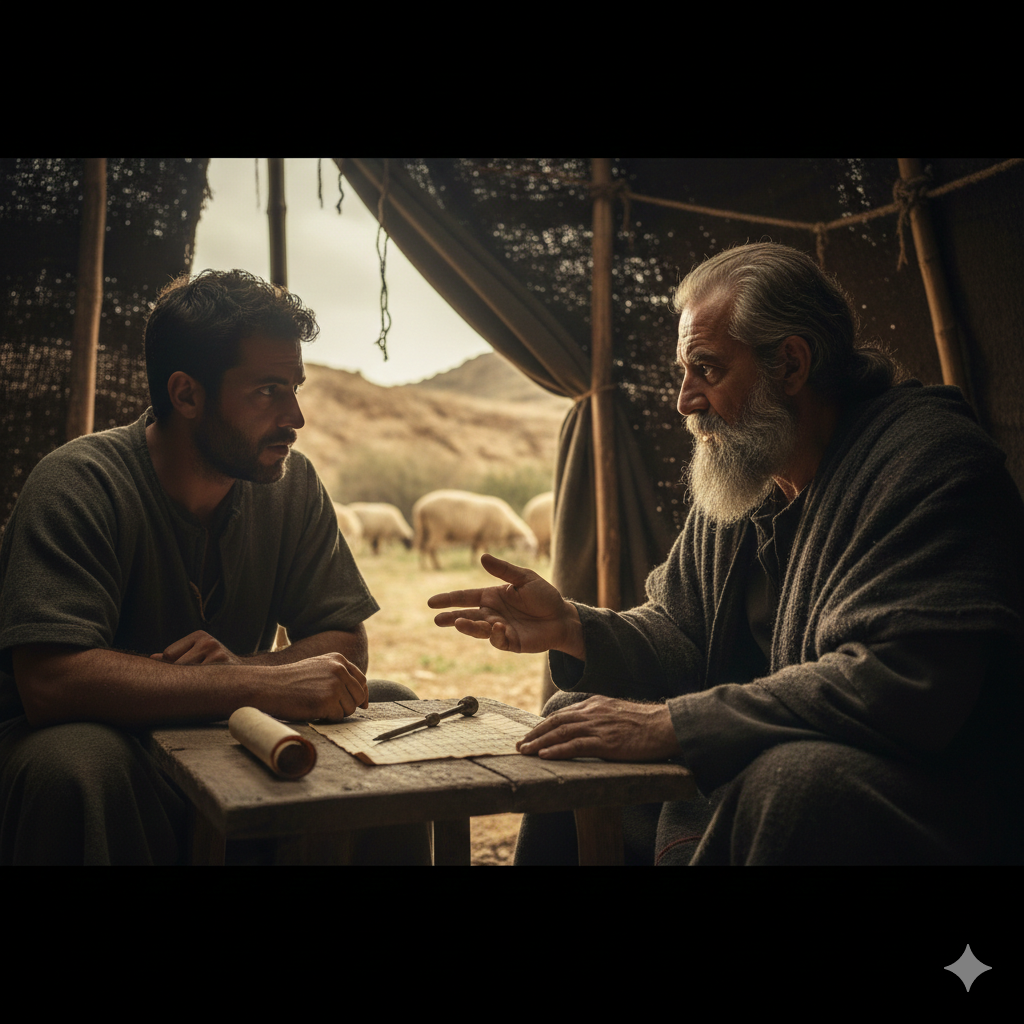
Step 3: Mixed Story Detection
The Quranic author has taken the setting of Moses (Midian) but spliced in the contract of Jacob (years of labor). In military reporting, if you say “Eisenhower signed the surrender in 1991,” you’ve conflated two eras. The “Confirmation” has mixed up the logs of two different prophets.
Approach this as an investigator, not an aggressor:
If your friend says, “Maybe both prophets had the same experience,” focus on the Unique Signatures.
“The Torah is corrupted. The ‘original’ Torah had the contract for Moses, but the Jews took it out.”
“Why would they take a contract out of Moses’ life but leave an almost identical one in Jacob’s? It doesn't make sense. Plus, the Quran says it ‘confirms’ what was with the people in the 7th century. If that record said ‘No contract,’ and the Quran says ‘Yes contract,’ that is a contradiction. We have to deal with the text as it is, not as we wish it was.”
Mixed Story Detection is a powerful tool. It shows the Quran functions like 7th-century oral folklore—remembering the “vibe” but mixing up the “coordinates” and “contracts.” This walkthrough demonstrates that the “Paper Trail” of the prophets has a major break in it.