
In the military, we rely on something called “Incident Reports.” If a squad comes back from a patrol and the lead sergeant says they were ambushed by three men at a specific crossroads, that report becomes the “Blueprint” for what happened. If a different report comes in later claiming to be a “confirmation” of that same event, but it says the squad leader actually knew the ambush was a ruse and never believed the men were dead, we have a problem. The integrity of the intel depends on the consistency of the narrative.
As we move along in our audit, we come to The Quran’s Surah 12—Surah Yusuf—which calls itself the “best of stories.” But our mission is the Surah 4:82 Test. If the Quran claims to confirm the previous revelation, the “Incident Report” of Joseph’s life should match the historical Blueprint found in Genesis.
The Claim
The Quran claims to be a “confirmation” of the scriptures that came before it. It also presents its own internal test: if it contained contradictions, it could not be from God (Surah 4:82).
“It is not a fabricated story, but a confirmation of what was before it…”
To pass the audit, the narrative sequencing and the roles of the key players in the Quran must be consistent with the “Blueprint” in the Torah. Factual changes to character psychology or historical identities identify a narrative breakdown.
If the "Confirmation" changes the psychological reality of the Patriarch—from a man truly grieving a dead son to a man who suspects his sons are lying—the narrative integrity is broken. In military reporting, losing names and specific roles is a classic sign of a "Summary Report" written by someone who has lost the primary data.
Evidence & Comparison
1. Jacob’s Knowledge: Mourning vs. Suspicion
In the “Blueprint,” when the brothers bring Joseph’s tunic, Jacob is completely convinced of Joseph’s death. This grief is the catalyst for the entire family’s journey.
“...‘It is my son’s tunic. A wild animal has devoured him; Joseph has surely been torn to pieces!’ ... and he refused to be comforted.”
In the Quran, Jacob’s reaction is fundamentally different. He immediately suspects a conspiracy.
“And they brought at his shirt with false blood. [Jacob] said, ‘No, but your souls have enticed you to something, so patience is most fitting…’”
2. Named Roles vs. Anonymous Brothers
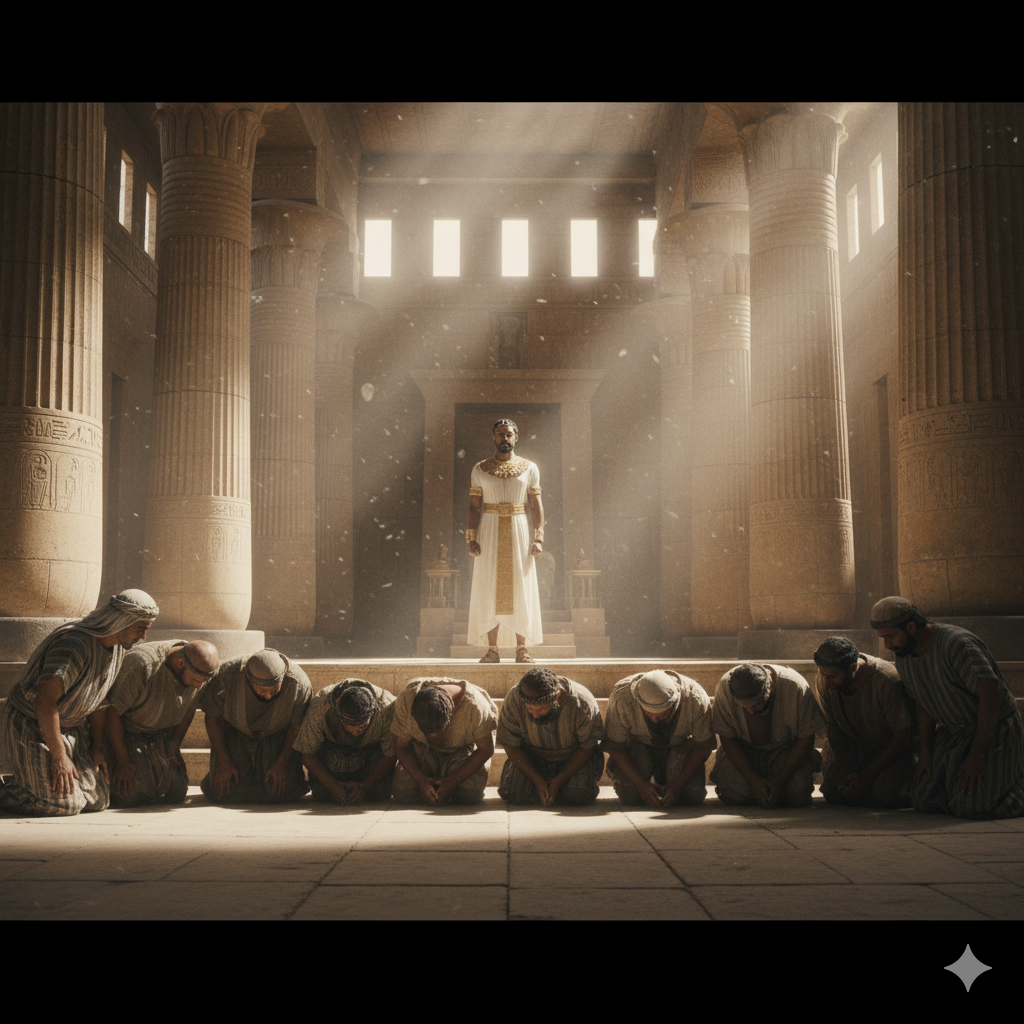
In the “Blueprint,” the brothers are individuals with names and specific roles. Reuben tries to save him from the pit; Judah suggests selling him to save his life. In the Quran, these signatures are erased; the brothers act as a collective “they” or an anonymous “speaker among them” (Surah 12:10).
3. The Timing of the Reveal
The “Blueprint” builds toward a specific climax where Joseph reveals himself only after Judah offers to take Benjamin’s place as a slave, proving a change of heart. In the Quran, Joseph reveals himself to Benjamin privately much earlier (Surah 12:69), fundamentally altering the redemptive arc.
Think about a family story. If your cousin tells the same story but forgets the names of your uncles and changes whether your grandfather actually believed the story or not, you’d say he “got the story wrong.” Use this to explain why details matter:
If your friend says, “The Quran focuses on the moral lesson, not the names,” stay focused on the Confirmation claim.
“The Torah was corrupted by scribes. The Quran came to restore the correct version of the story.”
“But the detail in Genesis—that Jacob truly believed Joseph was dead—is what makes the story work as a test of faith. If Jacob always suspected a lie, the weight of his grief is gone. Furthermore, the Quran points to the Torah that was 'in the hands' of the 7th-century people. If that record matches our Genesis today, then the Quran is contradicting the paper trail it claims to verify. Does a contradiction like that pass the Surah 4:82 Test?”
In this audit, we are looking at Narrative Erosion. This happens when oral tradition preserves the “gist” but loses the “anchors” (names and historical sequencing). By showing that the Quran reflects a “summarized” version that contradicts the detailed “Incident Report” in Genesis, you are demonstrating that the text fails its own consistency test.