
In the military, we have a healthy respect for “Archival Reality.” When you’re looking at a mission log from twenty years ago, you don’t care about rumors. You care about what was written down at the time of the event. There’s a common tactic in psychological operations called “History Scrubbing”—where an entity tries to claim that a past event changed everything, but they can’t produce a single document to prove it.
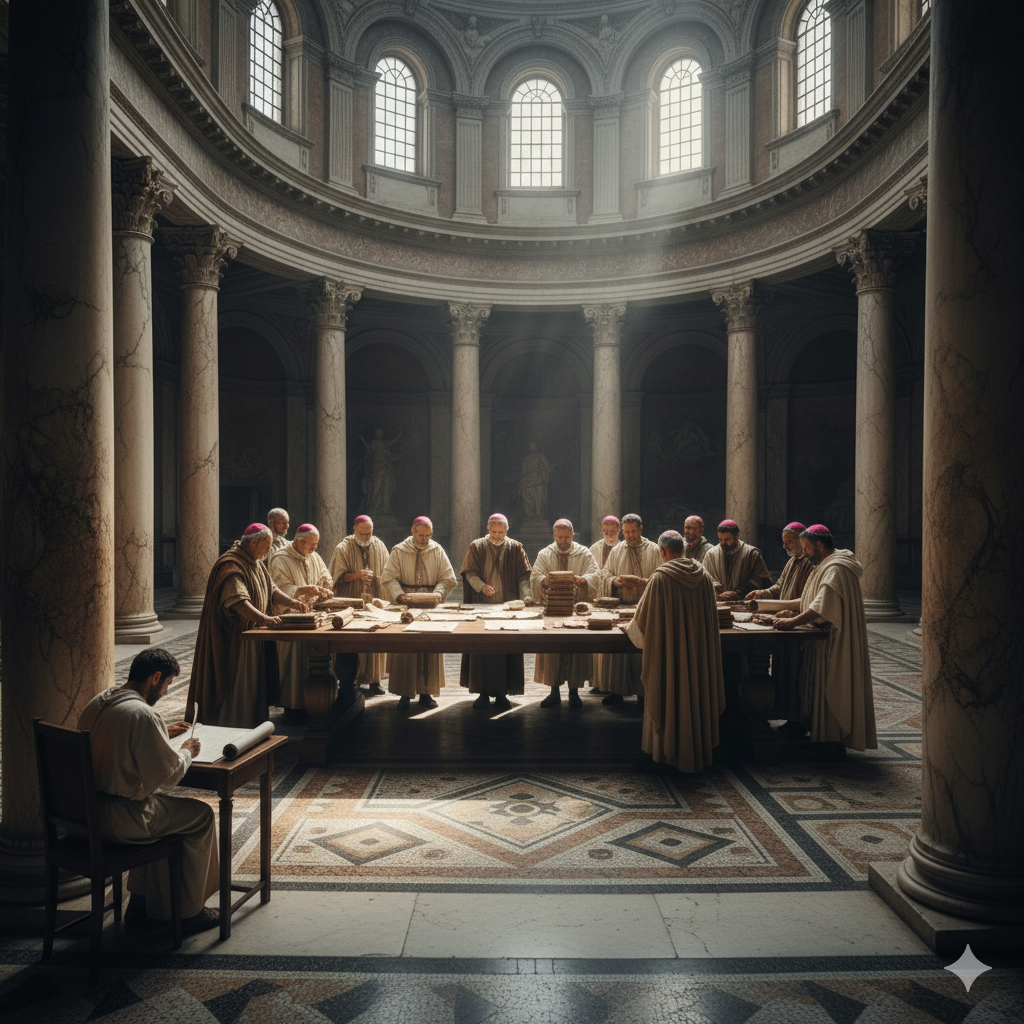
When you use the Surah 4:82 Test to point out that the Quran’s “Confirmation” doesn’t match the “Blueprint” of the previous scriptures, you will often run into the “Nicaea Myth.” Your friend might say, “Of course it doesn’t match! The Council of Nicaea in 325 AD changed the Bible and invented a new religion.” Today, we are auditing the paper trail of 325 AD. If the myth is true, the Quran’s own claim to be a “confirmation” is in serious trouble.
The Claim
The “Nicaea Myth” claims that Constantine and a group of bishops “voted” on which books to keep and effectively corrupted the previous scriptures. However, the Quran, writing 300 years after Nicaea, says:
“And let the People of the Gospel judge by what Allah has revealed therein...”
For the Surah 4:82 Test to hold, the Quran must be consistent with the “Blueprint.” If Nicaea had already “scrubbed” the Gospel in 325 AD, why would the Quran tell Christians in 610 AD to judge by what is in it?
If the Quran is a divine "Confirmation," it is confirming the post-Nicaea text available in the 7th century. If that text contradicts the Quran (on things like Mary's genealogy), you can't blame Nicaea. Blaming Nicaea implies the Quran came to confirm a book it knew was already corrupted.
Evidence & Comparison
1. The Paper Trail (Manuscripts)
In the military, we look for physical evidence. We have complete manuscripts of the Bible—like Codex Sinaiticus and Codex Vaticanus—that date to the same era as the Council of Nicaea. These manuscripts contain the same historical narratives, names, and genealogies found in the biblical text used today. There is no evidence of a “mass rewriting.”
2. The Historical Agenda
The Council of Nicaea was concerned with a specific theological dispute (Arianism), not with the “Canon” of the Bible or changing the stories of the prophets. The myth that they “voted” on the books is a later folklore that has no basis in the surviving contemporary records of the council.
3. The Breakdown
Under the Surah 4:82 Test, the “Nicaea Myth” creates a massive internal contradiction: The Quran claims to confirm the books the Christians had in the 7th century, yet those books are the same post-Nicaea texts we have today. You cannot use Nicaea as an “escape hatch” because the Quran gave those books its seal of approval 300 years after the council.
Bridge the gap by focusing on the timeline:
If your friend says Constantine forced changes, use the Evidence Reset.
“The ‘true’ Gospel of Jesus was hidden or destroyed at Nicaea, and only the Quran has the original stories now.”
“But the Quran doesn’t say the Gospel was hidden. It says it’s a ‘confirmation’ of the scripture that was with them (Surah 7:157). If the true book was gone, Muhammad couldn’t have confirmed it. If the book that was ‘with them’ in the 7th century contradicts the Quran, then the claim of ‘confirmation’ is broken. We have to deal with the paper that exists.”
The Nicaea myth is often used to explain away the “much contradiction” mentioned in Surah 4:82. By anchoring the conversation in the Quran’s own 7th-century context, you show that the “Nicaea Escape Hatch” is logically closed. If the Quran validates the Gospel of 610 AD, it is responsible for matching its details.