
In the military, we have a strict protocol for “Direct Attribution.” If you are writing a report on a meeting with a high-ranking official, you have to quote them accurately. If your report says, “The General denied having any troops in the sector,” but the official mission log shows the General saying, “I have three battalions on that ridge,” your report isn’t a “confirmation”—it’s a fabrication. Accurate quoting establishes the credibility of the source.
When we audit the Quran’s claim to be a “Confirmation” of the previous scriptures, we have to look at the words attributed to Jesus. The Quran claims that Jesus never claimed to be divine and, in fact, explicitly denied it. But when we look at the “Blueprint”—the Gospels that the Quran claims to confirm—we find a massive contradiction in the “Direct Attribution.” Today, we are auditing the testimony of Jesus under the Surah 4:82 Test.
The Claim
The Quran positions itself as a text that corrects “exaggerations” while simultaneously claiming to confirm the original Gospel (Injil). Surah An-Nisa 4:82 challenges us to look for inconsistencies:
“They have certainly disbelieved who say, ‘Allah is the Messiah, the son of Mary’ while the Messiah has said, ‘O Children of Israel, worship Allah, my Lord and your Lord...’”
Furthermore, Surah 5:116 depicts Jesus being interrogated by God and denying that he ever told people to take him as a deity. The Quranic claim is that Jesus's own testimony explicitly rejects his divinity.
In military terms, the “Confirmation” is reporting a “Direct Denial” when the “Original Log” (the Blueprint) contains a “Direct Affirmation.” These two reports cannot both be accurate reflections of the same historical event. A "Confirmation" that reverses the core testimony of its central character identifies a narrative collapse.
Evidence & Comparison
To perform the audit, we must look at the “Blueprint”—the Gospel records that existed for over 500 years before the Quran was revealed.
1. The “I AM” Signature
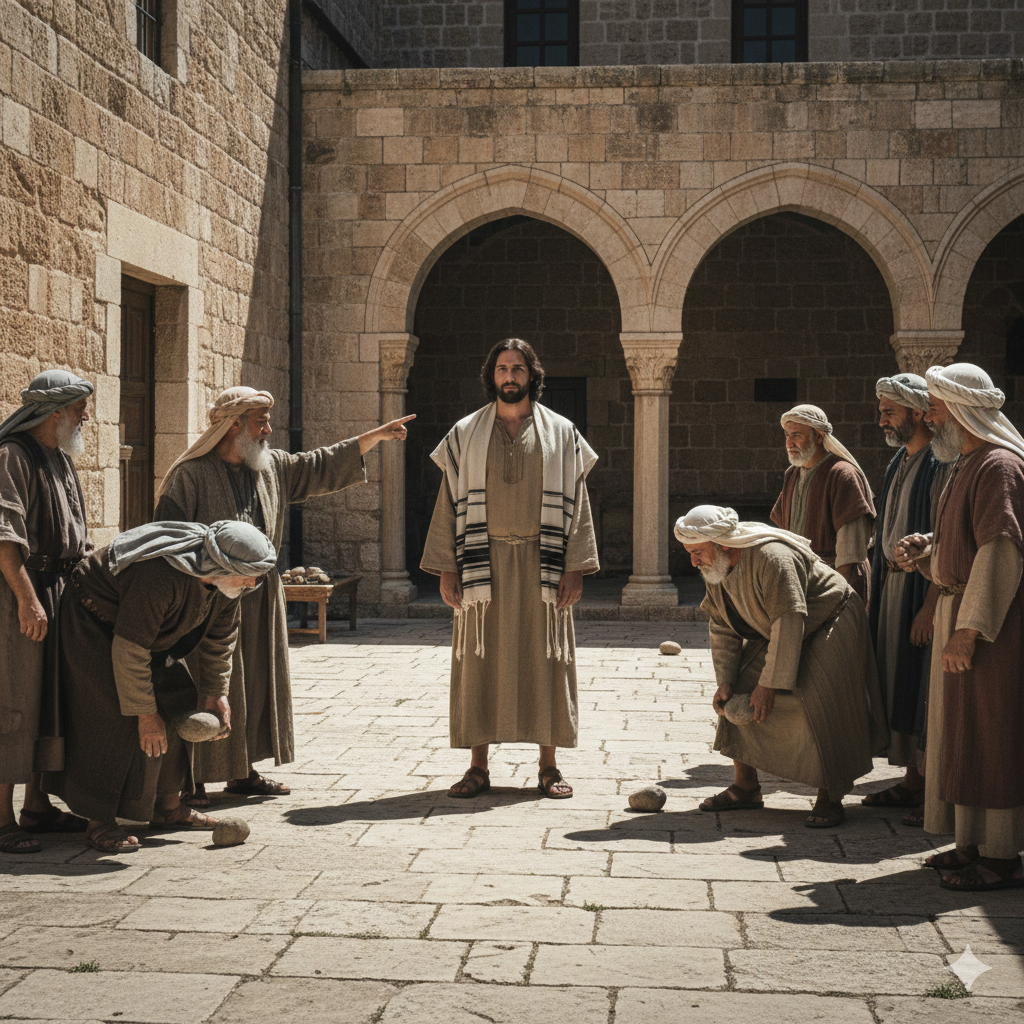
In the Gospel of John, Jesus makes several statements that his listeners clearly understood as claims to divinity. By using the phrase “I am,” Jesus was using the divine name of God from Exodus 3:14.
“Jesus said to them, ‘Truly, truly I say to you, before Abraham was born, I am.’ Then they took up stones to cast at him...”
The listeners didn't stone him for saying “worship God alone”; they stoned him because he claimed the divine name for himself.
2. The Shared Authority Signature
Jesus frequently spoke of himself in ways that no “mere messenger” ever did:
- John 10:30: “I and the Father are one.”
- John 14:9: “He who has seen Me has seen the Father…”
3. The Narrative Contradiction
Under the Surah 4:82 Test, we find a binary conflict: The Blueprint shows Jesus claiming eternal pre-existence and oneness with the Father. The Confirmation depicts him explicitly denying these things. If the “Blueprint” says Jesus claimed it, and the “Confirmation” says he didn’t, the audit identifies a human origin for the later report.
When a friend says, “Jesus never claimed to be God,” bridge to the “Historical Log”:
Do not get sidetracked into how Jesus is God (Phase 2). Stay on the paper trail.
“The ‘real’ Gospel didn’t have those verses. The disciples and later Christians added the ‘I AM’ statements to make Jesus into a god.”
“But the Quran says it confirms the Gospel that was with them in the 7th century. We have manuscripts from long before the 7th century that contain all those statements. If the Quran was ‘confirming’ a book that already had those ‘additions,’ then it was confirming a lie. But if the Quran is the truth, it should match the history. If the original record says ‘Yes’ and the confirmation says ‘No,’ the audit identifies an inconsistency.”
In Phase 1, we are identifying Attribution Inconsistency. By showing that the historical record contains claims the Quran says were never made, you are demonstrating that the Quran fails its own test of consistency. The “Direct Attribution” report in the Quran is factually at odds with the established “Mission Log” of the Gospels.