
In the military, before a building is cleared or a strike is authorized, you have to perform “Target Verification.” You don’t just take a whisper over the radio as the gospel truth. You check the coordinates on the map, you look at the drone feed, and you compare it to the original mission briefing. If the briefing says the target is a warehouse in the north, but the radio says it’s a mosque in the south, you stop. If the data doesn’t match the “Blueprint,” the mission is a “No-Go.”
Today, we’re doing our first full “Target Verification” of a Quranic claim. We aren’t just talking about the method; we are putting it into practice. We are going to audit a specific character in the Quranic narrative to see if his presence passes the Surah 4:82 Test.
The Claim
The Quran identifies itself as a divine “Confirmation” (Musaddiq) of the scriptures that came before it (Surah 5:48). To test this claim, we perform an audit on a specific “Coordinate”: the character of Haman.
"And Pharaoh said, ‘O eminent ones, I have not known for you any god other than me. So kindle for me, O Haman, [a fire] upon the clay and make for me a tower that I may look at the God of Moses…’"
In the Quran, Haman is identified as a high-ranking minister and architect for Pharaoh during the time of Moses. The claim we are auditing is that Haman was a contemporary of Moses in Egypt.
We are checking for "Chronological Collapse." If the Quran places a person in the wrong country and the wrong century, it creates a factual contradiction that identifies a human source according to Surah 4:82.
Evidence & Comparison
To perform the audit, we lay the “Confirmation” over the “Blueprint”—the historical and scriptural records that the Quran claims to verify.
1. The Blueprint: Historical Timeline
In the Blueprint (the Torah and the historical record of the Israelites), Moses and Pharaoh lived during the New Kingdom of Egypt (approx. 1450–1250 BC). There is no record of a minister named Haman in ancient Egyptian history or court documents.
2. The Identity of Haman (The Coordinate)
We find the specific “Coordinate” for Haman in the Blueprint, but it’s in a completely different era and location.
"After these events King Ahasuerus honored Haman, the son of Hammedatha the Agagite, and promoted him..."
- Geography: The Blueprint places Haman in Persia (modern-day Iran). The Confirmation places him in Egypt.
- Chronology: The Blueprint places Haman during the reign of Xerxes I in approx. 480 BC. The Confirmation places him with Moses in 1450 BC.
- The Gap: There is a 1,000-year gap and a 1,000-mile distance between the two accounts.
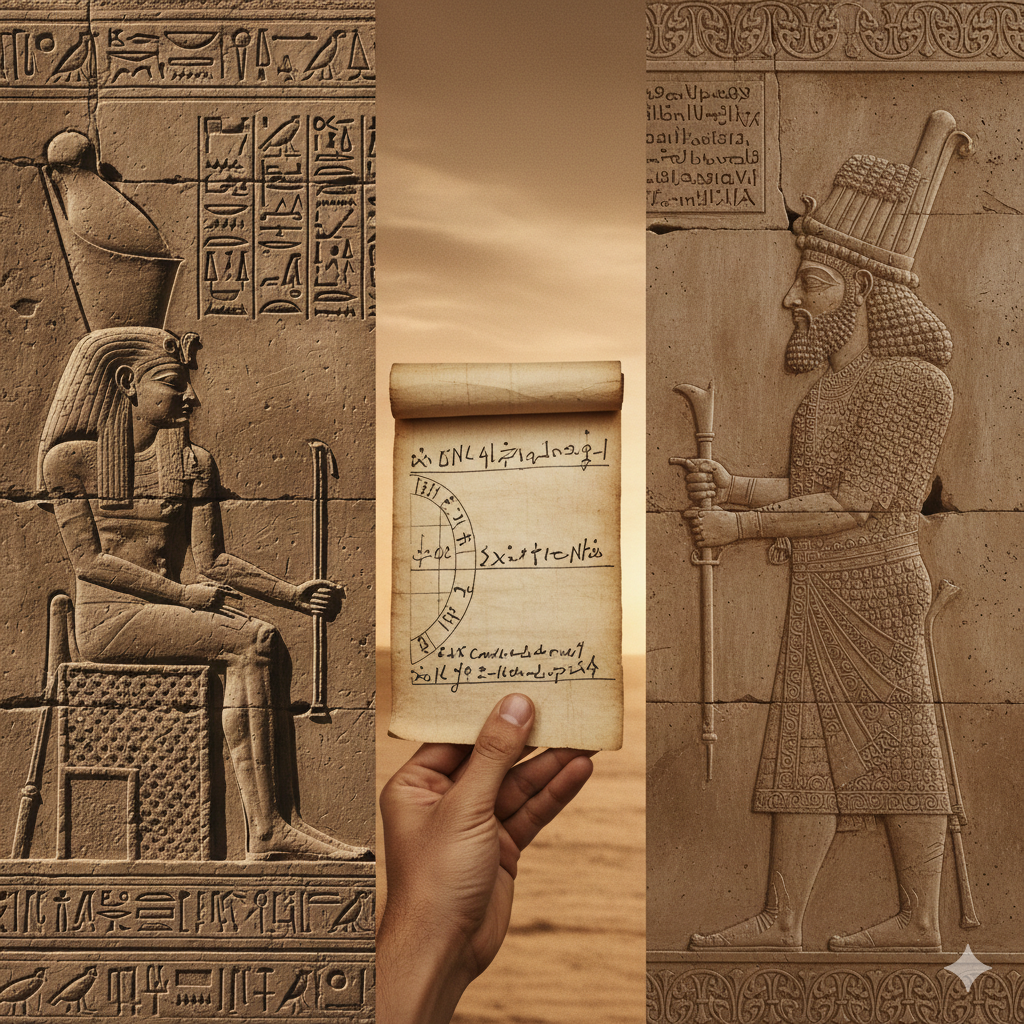
3. The Verdict of the Surah 4:82 Test
Under the Surah 4:82 Test, we ask: is this a contradiction? If the Quran is a divine “Confirmation,” how did it place a Persian official from the 5th century BC into an Egyptian court in the 15th century BC? According to Surah 4:82, finding “much contradiction” identifies a human source.
We’ve all seen movies where the filmmakers get the history wrong—like a character in a medieval movie wearing a digital watch. We call that an “anachronism.” You can say:
When you raise this with a friend, don’t try to “win” the point. Just present the facts of the audit.
“Haman is just an Egyptian title for a ‘head of stone-cutters.’ It’s not the same Haman from the Book of Esther.”
“There is no archaeological evidence that ‘Haman’ was ever a title in Egypt. However, Haman is a very specific, famous name in the Persian record. When we see the ‘Confirmation’ using a famous name from the Blueprint but putting it in the wrong era, it looks like a ‘Mixed Story.’ If we have to invent a title that doesn’t exist just to explain why the name is 1,000 years out of place, are we really reflecting on the text or making excuses for it?”
In this practice audit, we are demonstrating Chronological Collapse. This occurs when an oral storyteller remembers a “villain” and a “hero” but forgets the 1,000 years that separate them. You are showing that the Quran functions like a human summary of 7th-century rumors rather than a divine confirmation of history.