
There's a saying in the military: “Attention to detail saves lives.” When you’re looking at an intelligence report or a map, a single digit off in a coordinate can be the difference between hitting the target and a catastrophic error. When I served in Iraq, I learned that facts aren’t just suggestions—they are the foundation of reality.
We should be able to sit across a table, look at the documents, and see if the details hold up under fire. Today, we are putting the Quran’s internal claim—the Surah 4:82 Test—to work. If this book is a divine “confirmation” of the records that came before it, the details shouldn’t just be “close.” They have to be right. But when we look at the story of Moses’ marriage in Midian, we see a “Mixed Story” that suggests a breakdown in narrative integrity.
The Claim
The Quran identifies itself as a “confirmation” of the scriptures that came before it. Furthermore, it offers a specific challenge for its own divinity in Surah An-Nisa 4:82:
“Then do they not reflect upon the Qur’an? If it had been from [any] other than Allah, they would have found within it much contradiction.”
Our focus today is a narrative contradiction. The Quran claims that when Moses fled Egypt and arrived in Midian, he entered into a specific legal contract to win his wife: a term of labor lasting eight to ten years.
If the Quran is the perfect confirmation of the Torah, why does it attribute Jacob’s specific legal and biographical details to Moses? Mixing the signature trials of two different men identifies a human narrative error rather than a divine record.
Evidence & Comparison
Let’s look at the Blueprint—the earlier record in the Torah—and compare it to the Quranic account through the lens of the “Mixed Story Framework.”
1. The Quranic Account (The Marriage Contract)
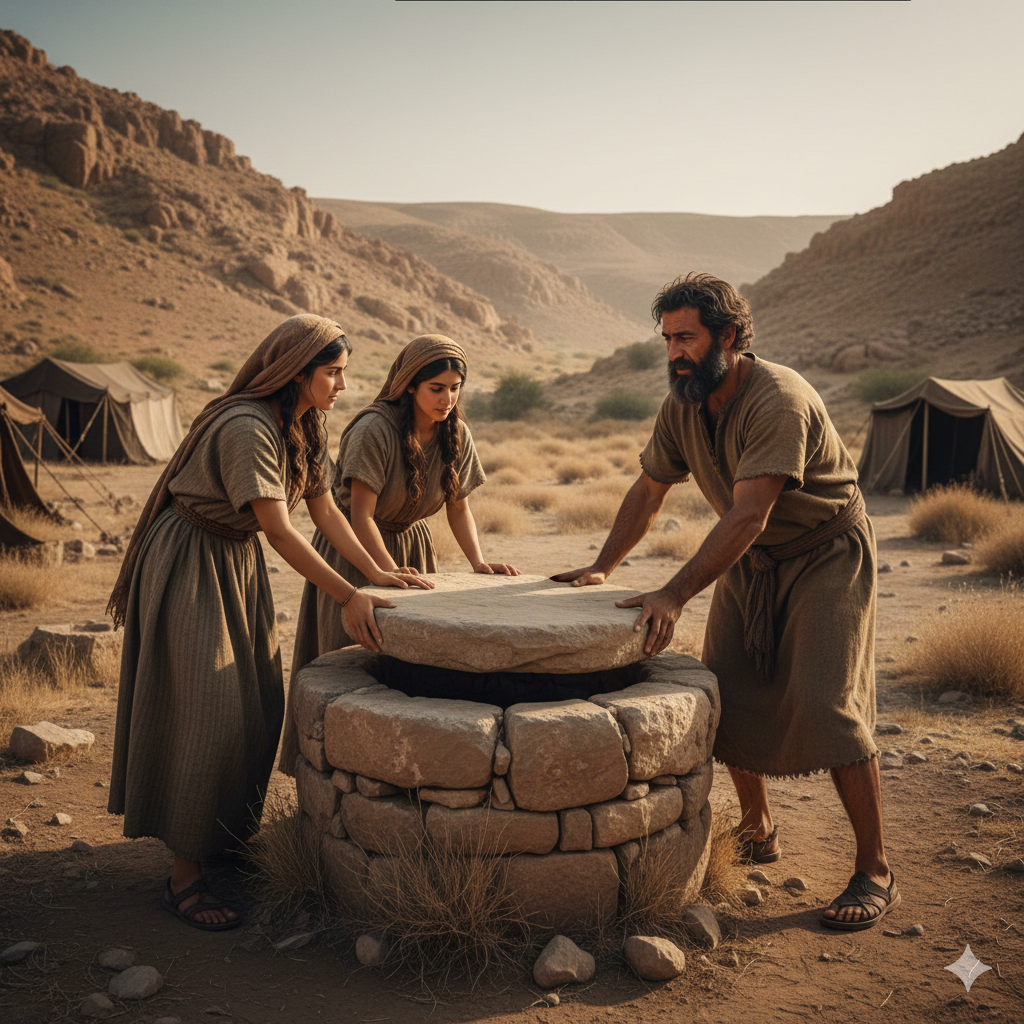
In the Quran, Moses helps two women water their flocks. Their father offers his daughter in marriage, but only under a specific condition of indentured service.
“He said, ‘Indeed, I wish to wed you one of these, my two daughters, on [the condition] that you serve me for eight years; but if you complete ten, it will be from you...’”
2. The Torah Account (The Moses Reality)
In the historical record (Exodus 2:21), Moses does flee to Midian and helps the daughters of Reuel. However, the marriage is an act of hospitality, not a labor contract. There is no mention of an eight-year or ten-year work requirement for the hand of Zipporah.
3. The Source of the “Mixed Story”: Jacob (Ya’qub)
Where does the “eight to ten years of labor for a wife” detail come from? In our Mixed Story Framework, we look for a similar narrative pattern in the Blueprint. We find it in the life of Moses’ ancestor, Jacob, hundreds of years earlier.
- The Event: Jacob waters sheep at a well, meets the daughters of a man in a distant land.
- The Contract: “I will serve you seven years for your younger daughter Rachel” (Genesis 29:18).
- The Result: Jacob serves two terms of seven years.
When you’re talking to a Muslim friend, start with the shared value of history. You can say:
If your friend says, “Well, maybe both Moses and Jacob had the same contract,” stay focused on the Audit.
“The Torah has been corrupted. The ‘original’ Torah probably said Moses worked for eight years, but the Jews changed it.”
“Actually, the Quran says it comes to ‘confirm’ what is currently in our hands. If the Torah was already ‘wrong’ about Moses’ marriage when the Quran was revealed, then the Quran wouldn’t be ‘confirming’ it—it would be overriding it. We can’t just claim ‘corruption’ every time the details don’t line up, or the Surah 4:82 Test becomes impossible to use.”
In the “Mixed Story Framework,” we see a pattern where oral traditions—which often blend stories over centuries—find their way into the text. Moses and Jacob are two different men with two different legacies. Mixing their marriage contracts is a detail that the Surah 4:82 Test demands we address as a narrative error.