
In the military, intelligence gathering is all about the “Key Players.” If you're conducting a briefing on a high-value target or a rescue mission, you have to be precise about who is in the building. You can’t just swap out the General’s adopted son for the General’s adopted grandson and expect the mission report to be considered accurate. Details matter because details establish the credibility of the source.
When we take the conflict out of the realm of emotion and put it onto the paper of history, we can perform a cold, hard audit. Today, we are auditing the rescue of Moses. The Quran claims to be a “confirmation” of the previous scriptures, but when we look at the identity of the woman who saved Moses from the Nile, the “intelligence report” changes. Under the Surah 4:82 Test, we have to ask: why does the confirmation contradict the original Blueprint?
The Claim
The Quran presents itself as a correction and a confirmation of the Torah. It explicitly invites us to test its divine origin by looking for inconsistencies in Surah An-Nisa 4:82. In the narrative of Moses’ infancy, the Quran identifies the woman who finds him as the wife of Pharaoh.
“And the wife of Pharaoh said, ‘[He will be] a comfort of the eye for me and for you. Do not kill him; perhaps he may benefit us, or we may adopt him as a son.’ And they perceived not.”
In the Torah, Moses is the adopted son of Pharaoh’s daughter—making him, legally, a grandson-figure to the Pharaoh. In the Quranic account, he is adopted by Pharaoh’s wife, making him a son-figure. Changing key players turns a "confirmation" into a narrative rewrite.
Evidence & Comparison
To perform an honest audit, we must look at the “Blueprint”—the historical record found in the Torah, written over a thousand years before the Quran.
1. The Torah Account (The Pharaoh’s Daughter)
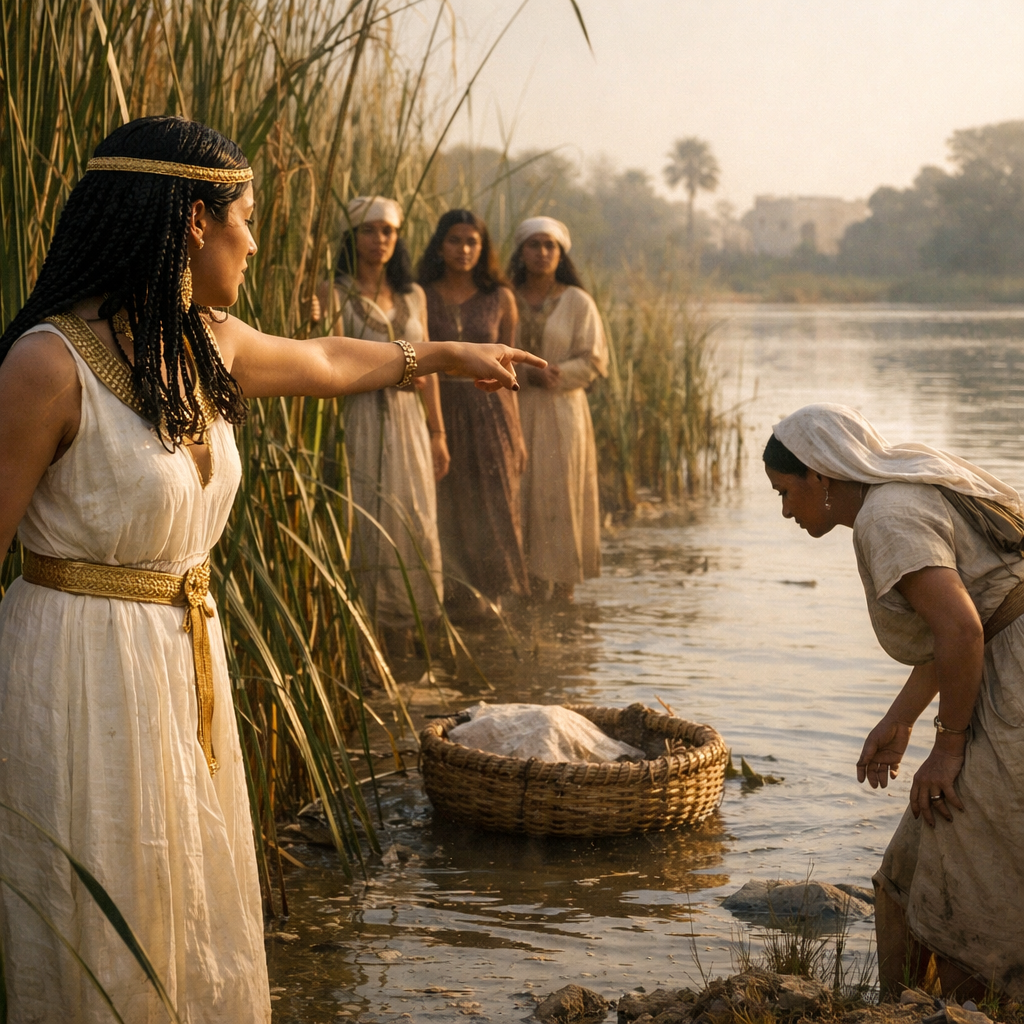
In the Book of Exodus, the identity of the rescuer is clear. It is not Pharaoh’s wife who goes down to the river; it is his daughter. This defines Moses' legal standing in the royal household.
“The daughter of Pharaoh came down to bathe at the Nile... and she saw the basket among the reeds... When the child grew up, she brought him to Pharaoh’s daughter and he became her son.”
2. The Mixed Story Framework
Why would the Quran swap the daughter for the wife? In oral traditions that circulated in the 7th century, stories often became “streamlined.” Identifying the woman as “Pharaoh’s Wife” creates a more direct domestic drama between a husband and a wife. However, it overrides the historical detail of the daughter’s role. It also erases the role of Moses' older sister Miriam, who orchestrates getting their mother hired as baby Moses' wet nurse — a detail that matters beyond this story. Miriam becomes a significant prophetic figure in her own right according to Exodus 15:20, and her name would later be conflated with Mary the mother of Jesus in the Quran, a separate issue we'll discuss in Lesson 5.2.
When a story is retold orally over centuries without reference to the written Blueprint, roles often shift toward more “central” characters (like a wife) rather than “secondary” ones (like a daughter). This is a hallmark of human storytelling, not divine revelation.
When you’re talking to a Muslim friend, frame this as a question of “Historical Precision.” You might say:
If they try to say, “Maybe Pharaoh had a wife and a daughter there,” stay focused on the Audit.
“The Bible was changed by people to make it seem like a daughter saved him. The Quran came to correct the mistakes the Jews made in their books.”
“Actually, Surah 5:43 asks why they would come to Muhammad for judgment when they have the Torah ‘in which is the judgment of Allah.’ If the Torah was already ‘corrupted’ regarding the basic identity of Moses’ rescuer, the Quran wouldn’t call it a source of ‘guidance and light.’ The Surah 4:82 Test asks us to consider if the error is actually in the later text that failed to match the original record.”
When the Quran changes a family relationship—turning a daughter into a wife—it isn’t just a different perspective; it’s a narrative rewrite. If the “confirmation” rewrites the “Blueprint,” it is no longer a confirmation. It is a different story entirely. By pointing this out, you are inviting your friend to apply the Quran’s own standard (Surah 4:82) to its own text.