
In the military, there's something called the “Order of Battle.” It is a disciplined, historical record of which units were where, who commanded them, and what specific tactics they used. If a mission report came across your desk that claimed General Patton led the charge at the Battle of Fallujah, you wouldn’t just be confused—you would know the report was fundamentally flawed. You can’t swap commanders and eras and still call it an accurate record.
When we take these narratives out of the realm of abstract “spirituality” and put them on the paper of history, we can perform a proper audit. Today, we are looking at the Quranic account of King Saul. The Quran claims to be a “confirmation” of the history that came before it, but when we audit the “Order of Battle,” we find a major tactical conflation. It attributes a very famous, very specific “River Test” to the wrong commander, separated by hundreds of years.
The Claim
The Quran positions itself as the ultimate standard of truth that confirms and guards the previous scriptures. It invites us to use the Surah 4:82 Test to verify its divine origin by looking for contradictions.
“And when Saul went forth with the soldiers, he said, ‘Indeed, Allah will be testing you with a river. So whoever drinks from it is not of me, and whoever does not taste it is indeed of me, excepting one who takes [from it] in the hollow of his hand.’ But they drank from it, except a [very] few of them…”
The Quranic author appears to have remembered a story about an ancient leader who tested his men at a river to narrow down his troops, but attributed it to Saul (the first King) instead of Gideon (one of the earlier Judges). This tactical conflation identifies a narrative error based on oral tradition rather than precise revelation.
Evidence & Comparison
To see if this “confirmation” holds up, we check the “Blueprint”—the original historical records in the Hebrew scriptures.
1. The Original River Test (The Gideon Reality)
The “River Test” is a famous event in the history of Israel, but according to the original records, it didn’t happen under King Saul. It happened generations earlier under a “Judge” named Gideon.
“So he brought the people down to the water. And the Lord said to Gideon, ‘You shall set apart by himself everyone who laps the water with his tongue as a dog laps, as well as everyone who kneels to drink.’ Now the number of those who lapped, putting their hand to their mouth, was three hundred men...”
2. Saul’s Actual Test
In the historical record of King Saul’s battles, he did test his men, but his test was a “fasting oath,” not a river test. In 1 Samuel 14:24, Saul places the people under an oath not to eat food until evening. The Quran has swapped the "fasting" signature of Saul for the "river" signature of Gideon.
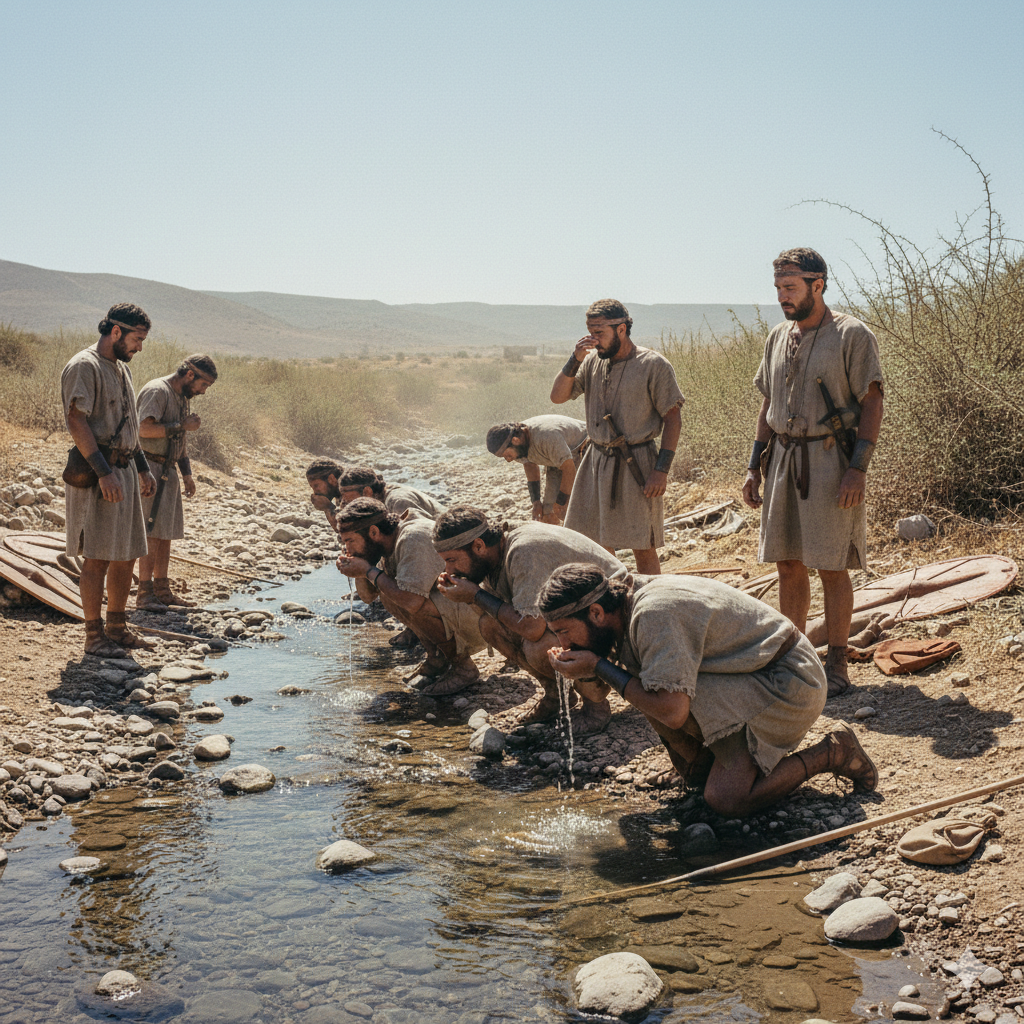
3. Tactical Conflation
In the Blueprint, Gideon's test reduced his army to 300 men for a specific theological reason. In the Quran, this exact scenario is dropped into the middle of Saul’s campaign. Swapping commanders and tactical signatures is a fundamental breakdown in the "Order of Battle."
Discuss the “Details of Leadership.” You might say:
If your friend says, “Maybe both Saul and Gideon did the same test,” use the military concept of a Signature.
“The Bible was changed by scribes. Maybe they took Saul’s story and gave it to Gideon, and the Quran is simply correcting the history.”
“The problem with the ‘correction’ theory is that the Quran claims to confirm what was already in the hands of the people in the 7th century. By then, the records of Gideon and Saul had been distinct for over 1,500 years. If the Quran is correcting a ‘mistake’ that no one knew existed, it’s not confirming the scripture; it’s rewriting it. If the ‘confirmation’ doesn’t match the ‘Blueprint,’ the audit fails.”
We are identifying Mixed Story Detection. This occurs when an oral culture remembers a high-impact narrative element (the River Test) but loses the “anchor” of who performed it. The Quran reflects the characteristics of 7th-century oral tradition—where stories became blended—rather than a divine, precise “confirmation” of historical fact.