
In the Army, there's something called a "Property Book." It was a ledger that tracked every high-value asset in the unit—from night-vision goggles to armored vehicles. If an asset went missing or showed up in the wrong place at the wrong time, it triggered an investigation. You had to account for the "Chain of Custody." If your report said a piece of equipment was in Kuwait when it was actually in North Carolina, your report was compromised.
When we look at the "Property Book" of the prophets, the most significant asset is the Ark of the Covenant. The Quran claims to be a "confirmation" of the previous scriptures, but when we audit the timeline of the Ark during the reign of King Saul, the Chain of Custody breaks down. Under the Surah 4:82 Test, we have to ask: why is this "divine asset" appearing in the wrong place at the wrong time?
The Claim
The Quran asserts its role as a "confirmer" of the Torah and the histories of the Israelites. Surah An-Nisa 4:82 challenges us to find a contradiction as proof of a non-divine origin.
"And their prophet said to them, 'Indeed, a sign of his kingship is that the chest [the Ark] will come to you in which is assurance from your Lord... carried by the angels. Indeed in that is a sign for you, if you are believers.'"
The Quranic narrative places the return of the Ark as a contemporary event used specifically to validate Saul’s appointment just before they go to war with Goliath.
In the historical Blueprint, the Ark had already been back in Israelite territory for over 20 years before Saul was ever anointed. The Quran re-locates this major historical event on the timeline to serve as a functional prop for Saul’s coronation, creating a factual contradiction.
Evidence & Comparison
To see if this "confirmation" matches the "Blueprint," we look at the historical record in the Books of Samuel.
1. The Ark’s Return (The Samuel Reality)
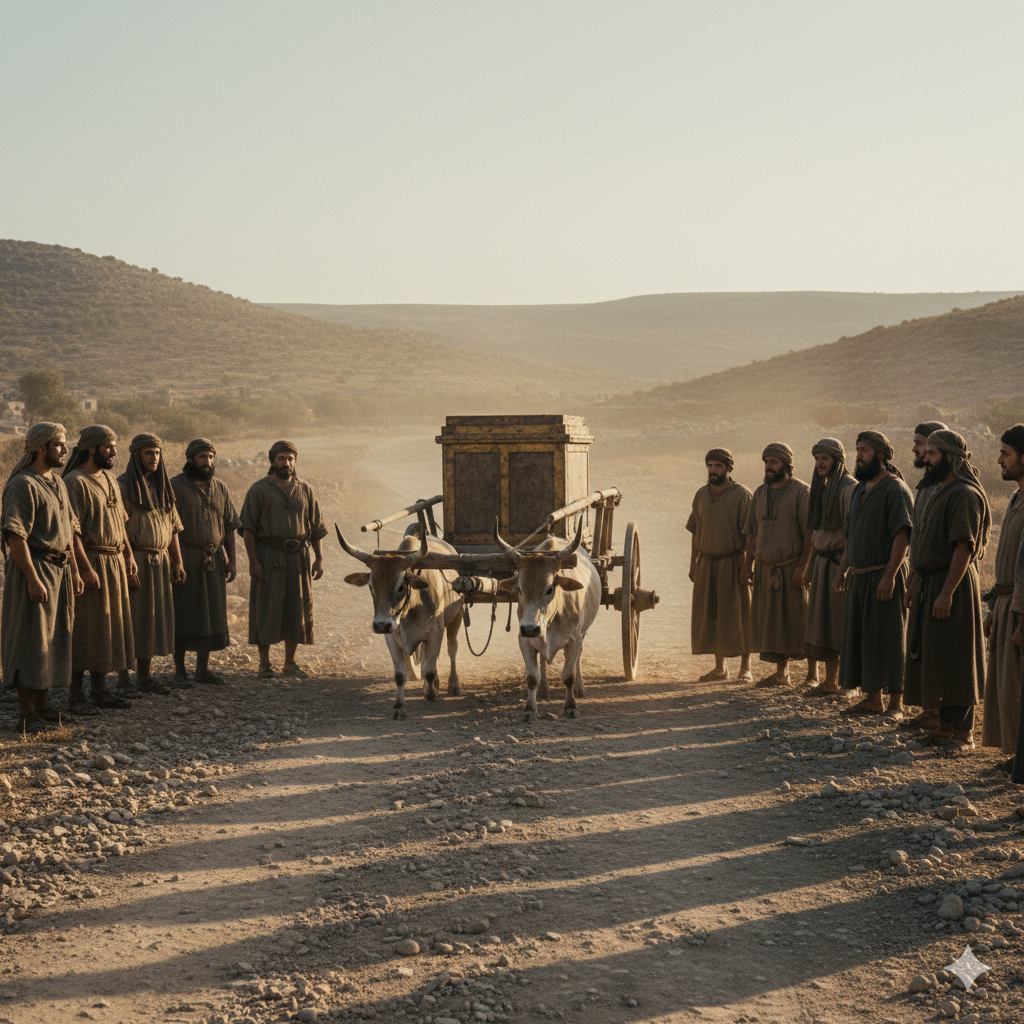
In the "Blueprint," the Ark was indeed captured by the Philistines, but its return happened long before Saul was ever king. It was returned during the time of Eli the priest and Samuel the prophet.
"Now the ark of the Lord had been in the territory of the Philistines for seven months... From the day that the ark remained at Kiriath-jearim, the time was long, for it was twenty years..."
2. The Chronological Gap
The Ark sat in a private home for 20 years before the people even asked for a king. Saul is later anointed in 1 Samuel 10. The Ark's return was not a "sign" for Saul’s kingship because the Ark had already been back in Israel for decades.
3. The Mixed Story Framework
This appears to be a Functional Conflation. In the Torah, Saul is given three specific signs to confirm his kingship (1 Samuel 10:1-9), none of which involve the Ark. The author of the Quran appears to have blended the thematic importance of the Ark with the narrative of Saul’s rise to power, creating a "Mixed Story."
Ask about "Signs of Leadership." You might say:
If your friend says, "Maybe the angels carried it from the house to Saul's location," focus on the purpose of the sign.
"The Bible is missing the part where the Ark was taken away again and then brought back for Saul. The Quran is filling in the gaps."
"The Quran calls the previous scriptures 'guidance and light.' If we have to invent an entire 'second capture' of the Ark that history never mentions just to make the Quran fit, we aren't performing an audit—we're making excuses. The simplest explanation is a narrative error."
We are identifying Functional Conflation. This occurs when a later author knows that "The Ark" and "King Saul" are both important, so they tether them together in a way that the original history does not. The Quran lacks the historical "Chain of Custody" required to be a true confirmation of the previous revelation.