
In the military, when they move a unit, they track every “Logistics Node.” If a report says a platoon was in Mosul, but the fuel receipts and mission logs show they never left Baghdad, the report is discarded. You can’t just place a historical figure in a location hundreds of miles away without a trail of evidence. Logistics don’t lie.
When we look at the life of Abraham, we have a very clear “Blueprint” of his movements. The Quran claims to be a “confirmation” of this history, but it places Abraham in a location—Mecca—that is nearly 800 miles away from his well documented logistics nodes. Today, we are auditing the claim that Abraham and Ishmael built the Kaaba. Does this claim pass the Surah 4:82 Test?
The Claim
The Quran explicitly states that Abraham and his son Ishmael established the foundations of the “House” (the Kaaba) in Mecca. This is a central claim of Islamic identity.
“And [mention, O Muhammad], when Abraham was raising the foundations of the House and [with him] Ishmael, [saying], ‘Our Lord, accept [this] from us. Indeed You are the Hearing, the Knowing.’”
According to this text, the Kaaba is not just a later building, but a prophetic construction intended as a place of monotheistic worship. It positions the 7th-century practice of Hajj as a continuation of Abraham's original legacy.
The distance from Hebron (where Abraham lived and was buried) to Mecca is approx. 800 to 1,000 miles of harsh desert. If the Quran is a divine "confirmation," why does it introduce a massive construction project 1,000 miles away that the original "Blueprint" record knows nothing about?
Evidence & Comparison
To see if this “confirmation” holds up, we must audit the “Blueprint”—the original records found in the Book of Genesis.
1. The “Blueprint” of Abraham’s Altars
The Torah is meticulously detailed regarding Abraham’s travels. Every time he moves to a significant location, the record notes the construction of a memorial:
- Shechem: Genesis 12:7 — “He built an altar there to the Lord.”
- Bethel/Ai: Genesis 12:8 — “He built an altar to the Lord...”
- Hebron: Genesis 13:18 — “...there he built an altar to the Lord.”
- Moriah: Genesis 22:9 — Abraham builds an altar to offer his son.
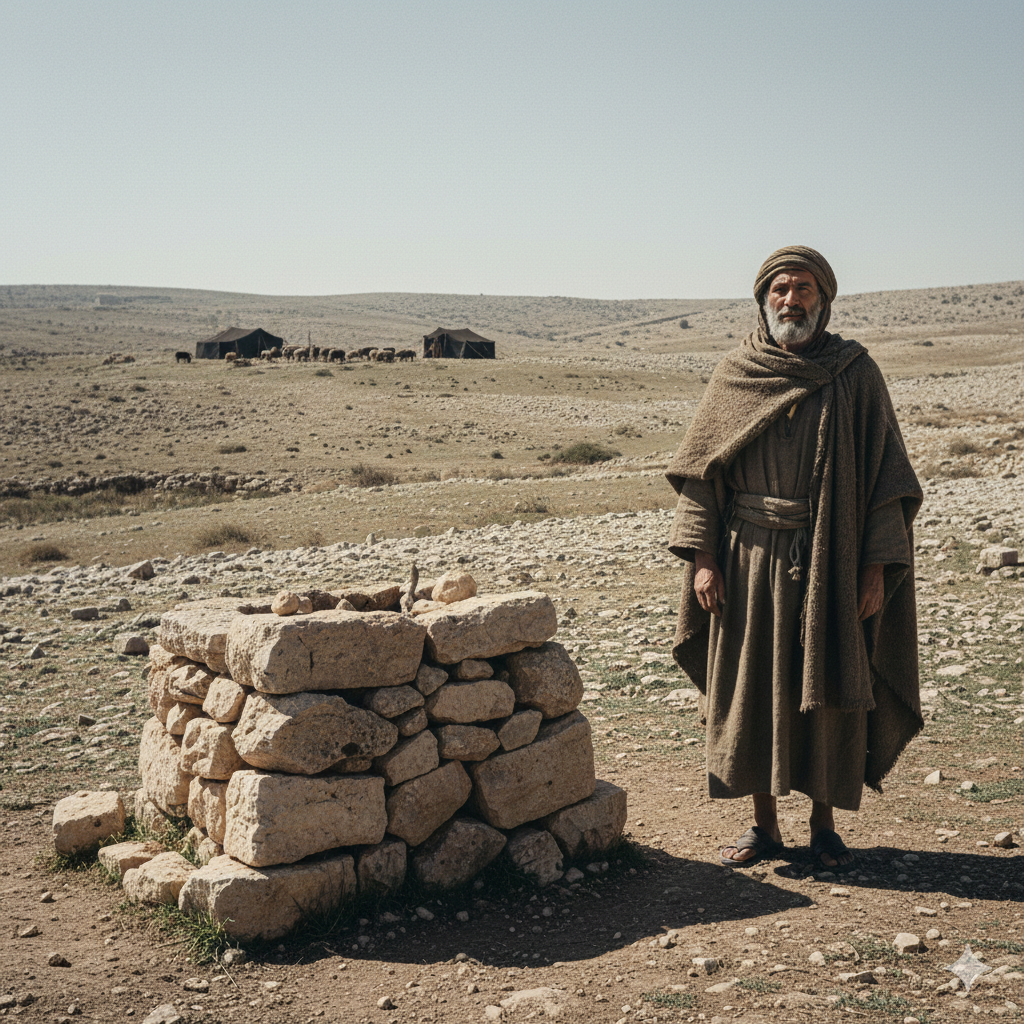
2. The Geographic Reality
All of these documented "logistics nodes" are located within a small geographic range in the land of Canaan. The "Blueprint" records Abraham’s short trip to Egypt, but it is completely silent on a 1,000-mile journey south to Mecca? It never mentions Abraham building a permanent "House" or cube-like structure. See the two accounts of Abraham's travels here: View the Map
3. The Breakdown
Under the Surah 4:82 Test, we have a major geographic contradiction. The Blueprint depicts Abraham as a nomadic shepherd whose worship is anchored in local, stacked-stone memorials in Canaan. The Confirmation depicts him as a long-distance traveler building a permanent sanctuary in a location never mentioned in the previous record.
Approach this through the lens of “The Paper Trail.” You might say:
If your friend says, “The journey was miraculous,” stay focused on the Audit.
“The Jews deleted the mentions of Mecca and the Kaaba from the Torah because they were jealous of the Arabs and wanted to claim Abraham only for themselves.”
“The Quran calls the Torah ‘the Criterion’ and ‘Guidance.’ If the Jews had the power to scrub a 1,000-mile journey and a massive stone building out of their history so thoroughly that not a single ancient manuscript remains with that detail, then the Torah wouldn’t be a reliable ‘guidance.’ If we have to assume the ‘Blueprint’ is a total lie to make the ‘Confirmation’ true, then the Surah 4:82 Test has failed.”
We are looking at Geographic Narrative Divergence. This happens when a later text tries to “re-home” a historical figure into a new sacred geography. By pointing out the 800-mile gap and the silence of the original record, you are showing that the Quranic claim functions as a 7th-century expansion rather than a divine confirmation of 2000 BC history.