
In the military, they have a “Redress of Records” process. If a soldier’s personnel file says they were born in Ohio, but their marriage certificate and family lineage records show they are from a completely different country, it triggers a security review. You can’t have two different identities for the same person in official government files. If the files don’t match, the integrity of the entire system is compromised.
When we look at the life of Ishmael, we are looking at the “Personnel File” of a prophet. The Quran claims to be a “confirmation” of the previous records, but when it comes to the family Ishmael built, the records diverge. Today, we are auditing the lineage of Ishmael’s wife. Under the Surah 4:82 Test, we have to ask: if the “Blueprint” says he married into one culture, but the “Confirmation” implies another, is the record still consistent?
The Claim
The Quran identifies Ishmael as a prophet and a co-builder of the Kaaba in the valley of Mecca. While the Quran does not explicitly name Ishmael’s wife, it anchors him geographically in the Arabian Peninsula to establish him as the progenitor of the Arabian lineage.
“Our Lord, I have settled some of my descendants in an uncultivated valley near Your sacred House, our Lord, that they may establish prayer…”
In Islamic tradition, Ishmael is said to have married a woman from the Jurhum tribe—a pure Arab tribe that settled in Mecca. This marriage is the “Personnel Record” required to link the Biblical prophet to the Arab people, specifically the Quraysh tribe of Muhammad.
The "Blueprint" provided in the Torah gives a specific origin for Ishmael's wife. If the Quranic tradition shifts his marital history away from the documented lineage to fit a new national narrative, it identifies a narrative rewrite rather than a divine confirmation.
Evidence & Comparison
To see if this “confirmation” holds up, we must audit the “Blueprint” in the Book of Genesis.
1. The Cultural Context of Hagar
To understand Ishmael’s marriage, we have to look at his mother, Hagar. The Torah is explicit about her origin: "Now Sarai, Abram’s wife, had borne him no children, and she had an Egyptian maid whose name was Hagar" (Genesis 16:1).
2. The Marriage Record (The Blueprint)
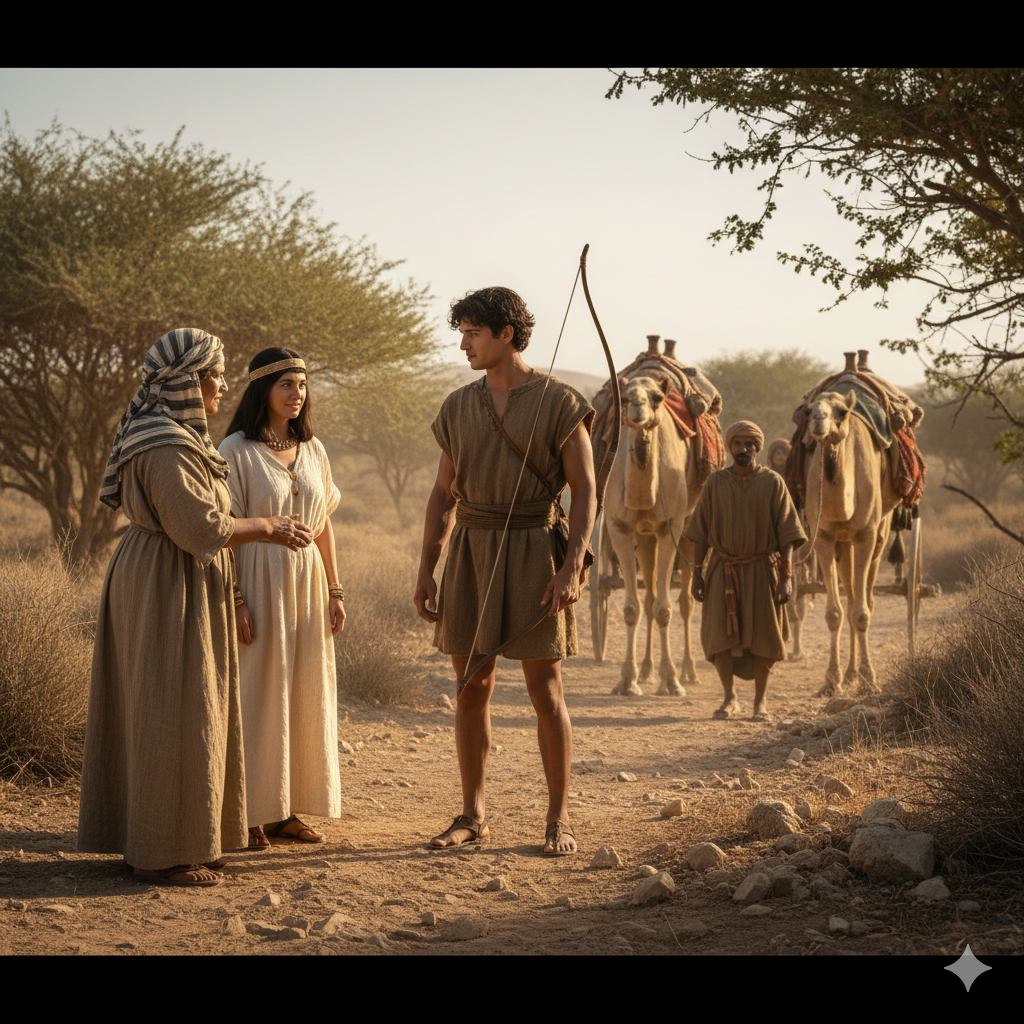
When Hagar and Ishmael were sent out into the wilderness of Paran (the border between the Sinai and the Negev), Hagar sought a wife for her son. Being an Egyptian woman, she sought a wife from her own people.
“God was with the lad, and he grew; and he lived in the wilderness and became an archer. He lived in the wilderness of Paran, and his mother took a wife for him from the land of Egypt.”
3. The Conflict of Lineage
- The Blueprint: Ishmael is 50% Hebrew and 50% Egyptian. He marries an Egyptian woman. His children are 75% Egyptian, 25% Hebrew. They are a Levantine/North African family unit.
- The Confirmation: Ishmael is settled in Mecca and marries an Arab woman from the Jurhum tribe. This makes his children part-Arab, creating the necessary genealogical link for Muhammad’s tribe.
Bring this up as a matter of “Maternal Influence.” You might say:
If your friend says, “Ishmael could have had more than one wife,” stay on the Audit.
“The Bible was altered by the Jews to hide Ishmael’s connection to the Arabs.”
“Why would the Jews care about an Egyptian marriage? If they were going to ‘corrupt’ the text to make him look bad, an Egyptian wife wouldn't do much. Marriage to an Egyptian fits the story perfectly because his mother was Egyptian. The Surah 4:82 Test asks: does the account create a contradiction? If the Blueprint says Egyptian and the Confirmation requires an Arab, that’s a narrative shift.”
In Phase 1, we are identifying Genealogical Reconstruction. This occurs when a later culture needs to “claim” a famous figure as their ancestor, so they modify the records. By pointing out the Egyptian marriage in Genesis 21, you are showing that the “paper trail” for Ishmael leads toward Egypt and the Sinai, not toward Mecca.