
In the military, “Land Navigation” is a core skill. If you are given a set of coordinates for a supply drop in the Sinai Peninsula, but you fly your aircraft 1,000 miles south to the Hijaz mountains in Saudi Arabia, you haven’t just made a small mistake—you’ve missed the entire theater of operations. In land nav, names of locations are tied to physical landmarks. If the map says “Paran” is next to “Sinai,” you can’t just decide later that “Paran” actually means “Mecca” without throwing the entire map into the trash.
When we look at the geographic coordinates of the prophets, we have to be precise. The Quran claims to be a “confirmation” of the previous scriptures, but Islamic tradition relies on a geographic re-mapping of the word “Paran” to place Ishmael in Mecca. Today, we are auditing the location of Paran. Does the Quranic claim hold up when the coordinates are shifted by a thousand miles?
The Claim
While the Quran does not use the word “Paran” (Faran), it identifies the location where Abraham left Ishmael as an “uncultivated valley” near the “Sacred House.”
“Our Lord, I have settled some of my descendants in an uncultivated valley near Your sacred House, our Lord, that they may establish prayer…”
Islamic tradition has historically identified this valley—and the “Wilderness of Paran” mentioned in the Torah—as the valley of Mecca. This identification is essential for the claim that Ishmael is the father of the Arabs in Mecca and that Muhammad is the fulfillment of prophecies regarding a “prophet from Paran.”
Coordinates are absolute. The Torah consistently places Paran in the Sinai Peninsula, adjacent to Israel's southern border. If the "Confirmation" moves this territory 1,000 miles south to Mecca, it isn't confirming the map—it's discarding it.
Evidence & Comparison
To perform the Surah 4:82 Test, we must look at the “Blueprint” to see where Paran is actually located.
1. Paran’s Proximity to Sinai
The Torah is very specific about the landmarks surrounding the Wilderness of Paran. It is consistently placed in the Sinai Peninsula, bordering the Negev desert (Southern Israel).
“...and the sons of Israel set out on their journeys from the wilderness of Sinai. Then the cloud settled down in the wilderness of Paran.”
2. The Coordinates of Kadesh
The “Blueprint” further anchors Paran by placing the famous site of Kadesh-barnea within its borders. Kadesh-barnea is a well-known historical site located on the border of modern-day Israel and Egypt.
“they proceeded to come to Moses and Aaron... in the wilderness of Paran, at Kadesh; and they brought back word to them…”
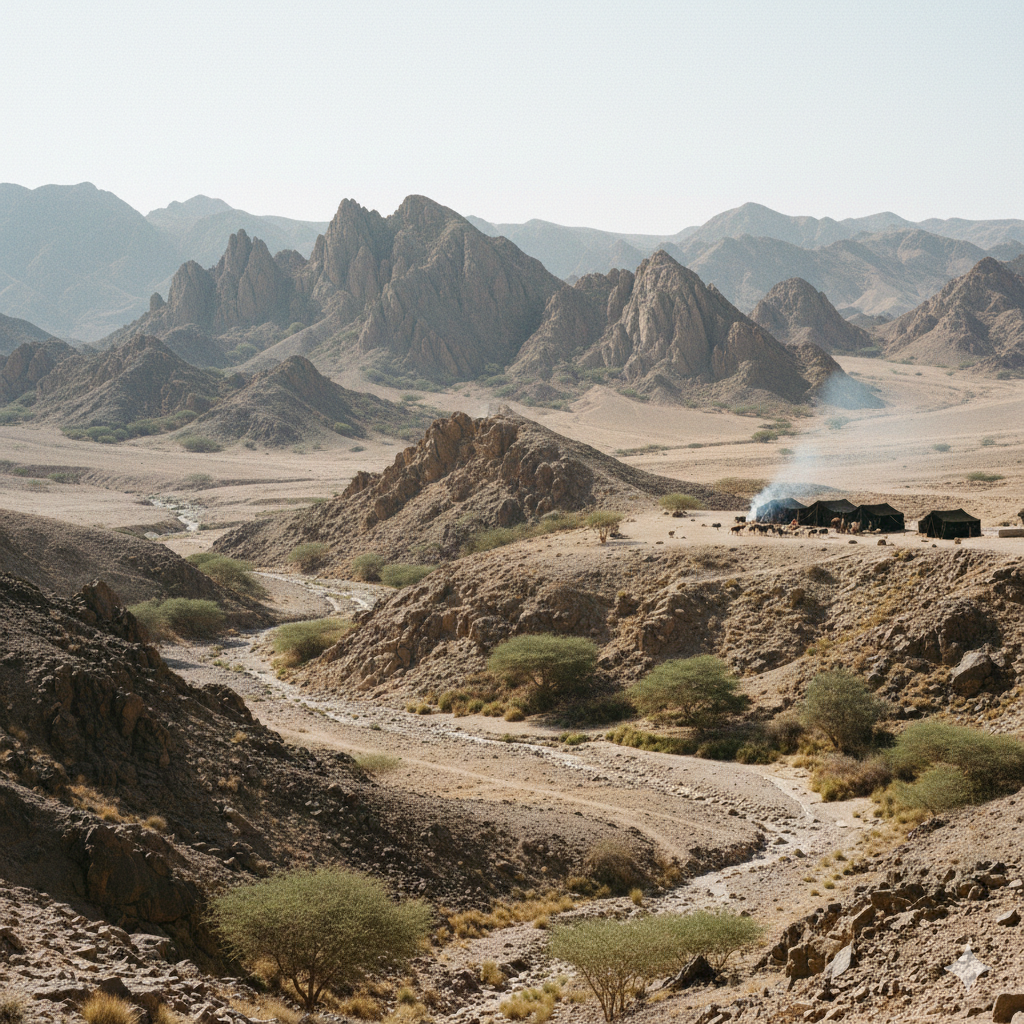
3. The Conflict of the Map
- The Blueprint (Torah): Paran is in the north, adjacent to Sinai and the southern border of Canaan (Israel). This is where Ishmael settled.
- The Confirmation (Tradition): Paran is equated with Mecca, 1,000 miles to the south, deep in the Arabian Peninsula.
Bring this up as a “Map Reading” question with a friend:
If your friend says, “The name Paran can apply to a large area,” use the Landmark Audit.
“Arab geographers and local traditions have called the mountains of Mecca ‘Faran’ for centuries. This proves the Bible was talking about Mecca.”
“The Torah—which the Quran says it confirms—gives us the coordinates of Paran next to Sinai and Israel. If later geographers moved the name ‘Faran’ south to Mecca to support a new narrative, that’s a ‘change’ to the map, not a ‘confirmation.’ If God’s word is consistent, why would the physical location move 1,000 miles between the two books?”
In Phase 1, we are identifying Geographic Relocation. This happens when a later movement needs to transplant the “blessing” of a historical location into their own territory. By showing that the Torah anchors Paran in the Sinai/Negev region, you are demonstrating that the “Mecca-as-Paran” claim is a 7th-century insertion that contradicts the record it claims to confirm.