
In the military, we differentiate between "Official Action Reports" and "Barracks Scuttlebutt." When you’re in a theater of operations like Iraq, stories travel fast. You might hear a rumor about a legendary firefight that gets bigger every time it’s told. But if you want the truth, you go back to the written Mission Logs. You check the coordinates and the dates. You don’t base a mission on a story that "everyone just knows"—you base it on the paper.
When we look at the life of Abraham, we have a very clear Mission Log in the Torah. The Quran claims to be a “confirmation” of that log. However, when it tells the story of Abraham being thrown into a giant furnace by a king (traditionally Nimrod), we are looking at "Barracks Scuttlebutt" written down centuries after the fact. Today, we are auditing the "Fire Tradition." Does it pass the Surah 4:82 Test?
The Claim
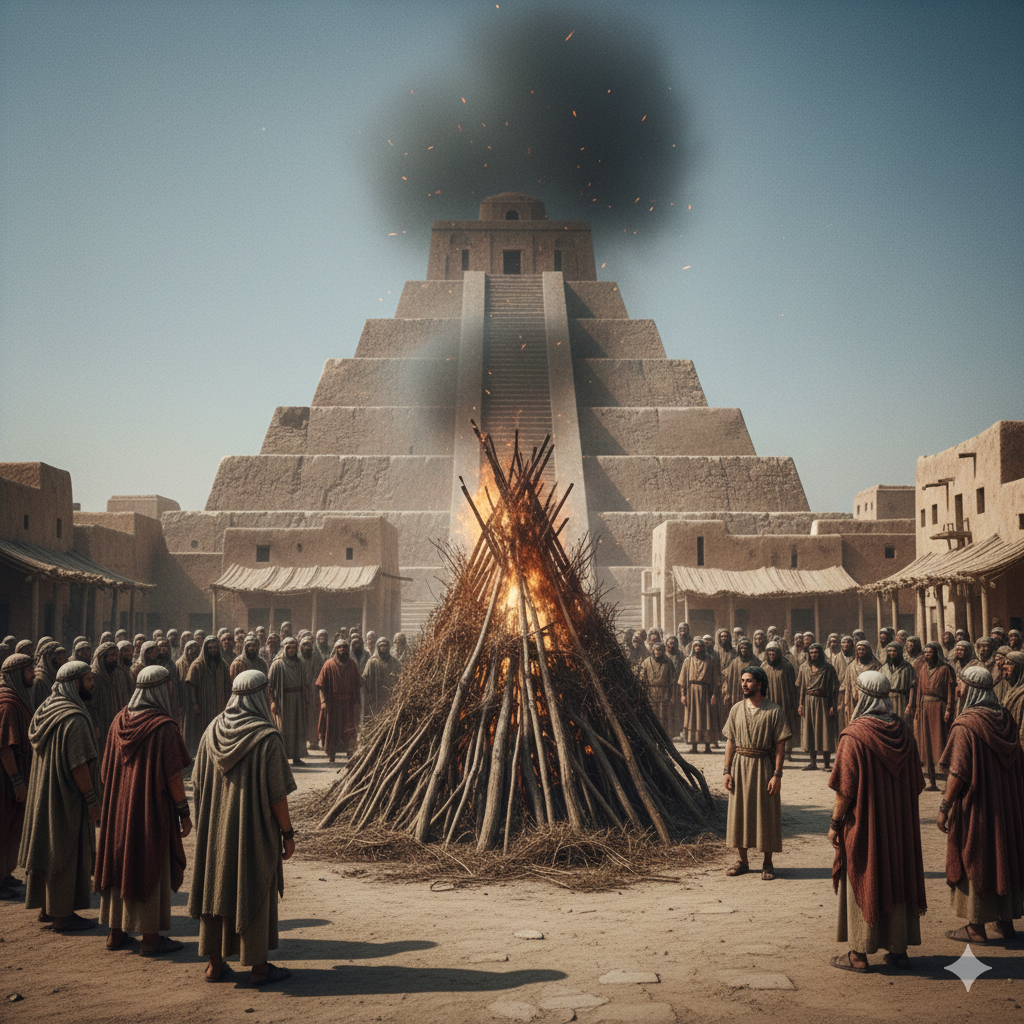
The Quran records a dramatic event where Abraham’s people attempt to execute him by fire for destroying their idols.
"They said, 'Burn him and support your gods - if you are to act.' We [Allah] said, 'O fire, be coolness and safety upon Abraham.'"
In various Islamic commentaries, this story is anchored to Nimrod, the "mighty hunter" mentioned in Genesis. For the Quran to be a "confirmation," this event should be part of the historical record of Abraham's life.
This story appears to be a "Mixed Story" originating from a linguistic pun. In the Torah, Abraham leaves the city of Ur (Sumerian for "City"). In Hebrew, the word Or means "Fire." Later folklore confused the two, claiming God brought him out of a "Fire" rather than a "City."
Evidence & Comparison
To perform the Surah 4:82 Test, we compare the account to the "Blueprint" (Torah) and the historical scuttlebutt of the era.
1. The "Blueprint" (The Silence of Genesis)
The Book of Genesis meticulously records Abraham’s departure from "Ur of the Chaldeans." It lists his family and wealth, but there is no mention of a trial by fire, a furnace, or an encounter with a king named Nimrod during his youth.
2. The Chronological Mismatch
In the "Blueprint," Nimrod is a figure from the distant past. He appears in Genesis 10 as the great-grandson of Noah. Abraham doesn't appear until several generations later in Genesis 12. You can't have a General from the Civil War leading a platoon in the Gulf War; they lived in different eras.
3. The Origin of the Legend
The story appears in the Jewish Midrash, a collection of folklore written down centuries after the Torah but before the Quran. A storyteller likely read "God brought Abraham out of the Ur (City)" and mistakenly interpreted it as "God brought Abraham out of the Or (Fire)." This linguistic pun was popular in 7th-century oral tradition and was eventually recorded in the Quran as fact.
We all love "Heroic Stories," but we have to check the sources. You might say to a friend:
If your friend says, "The Jews forgot the miracle," focus on the Timeline.
“The Jews removed the story because they wanted to hide the miracles. The Quran is restoring the truth.”
“Why would they hide a miracle that makes Abraham look like a hero? They kept the Red Sea and the plagues. The more likely explanation following the 'paper trail' is that the story was a later legend based on a play on words (Ur vs. Or). If the 'Confirmation' repeats a human error found in later folklore, it's not confirming the original revelation; it's confirming 7th-century rumors.”
In Phase 1, we are identifying Mixed Story Detection. By showing that the "Fire Tradition" has a clear origin in a Hebrew pun (Ur/Or), you are demonstrating that the Quran reflects the human errors of its environment rather than a divine "confirmation" of history. The "Barracks Scuttlebutt" made it into the official report.