
In the military, we have a “Challenge and Password” system. If you’re approaching a perimeter at night, the sentry gives a “challenge” word, and you must respond with the correct “password.” If you don’t have the password, you are treated as a threat. This system exists for a reason: authentication. You have to prove you belong to the same command before you’re allowed in.
When we look at the history of the prophets, there is a clear “Standard Operating Procedure” (SOP) for how God authenticates His messengers. The Quran claims to be a “confirmation” of the previous scriptures, but when we compare Muhammad’s first experience in the Cave of Hira to Moses’ experience at the Burning Bush, the “passwords” don’t match. Today, we are auditing the Prophetic Authentication pattern. Under the Surah 4:82 Test, if the method of calling a prophet changes from clear identification to traumatic confusion, is the record still consistent?
The Claim
The Quran identifies itself as a text that confirms previous revelations and follows the pattern of the prophets. Surah An-Nisa 4:82 tells us that a lack of contradiction is the proof of its divine origin. The first revelation given to Muhammad is recorded in Surah Al-Alaq 96:1-5:
“Recite in the name of your Lord who created—Created man from a clinging substance...”
According to the Quran and the primary historical traditions (Sira and Hadith), this encounter happened in the Cave of Hira. It was characterized by a sudden, overwhelming physical presence that demanded Muhammad “recite” despite his intense confusion and fear.
God initiates contact in the "Blueprint" with clarity, historical identification, and public signs. In the "Confirmation," an unidentified entity initiates contact through physical trauma and leaves the recipient in a state of suicidal despair. If the God is the same, why did the SOP for calling a prophet change so drastically?
Evidence & Comparison
To perform the Surah 4:82 Test, we compare Muhammad's experience to the “Blueprint”—the calling of Moses.
1. The Blueprint: The Burning Bush (Moses)
When Moses is called, the environment is miraculous, but the communication is orderly and self-authenticating from the very first word.
“...God called to him from the midst of the bush and said, ‘Moses, Moses!’ And he said, ‘Here I am.’ ... He said also, ‘I am the God of your father, the God of Abraham, the God of Isaac, and the God of Jacob.’”
- Identification: God immediately identifies Himself by Name and historical relationship.
- Response: Moses is in awe, but he is never confused about who is speaking.
- Clarity: No physical struggle; God gives clear missions and signs (the staff and hand).
2. The Conflict: The Cave of Hira (Muhammad)
In the Quranic account and its historical context, the encounter is fundamentally different in nature.
- Lack of Identification: The entity does not initially identify itself as Gabriel or as the God of Abraham. It simply commands, “Recite.”
- Physical Trauma: Traditional accounts (Sahih al-Bukhari 3) describe the entity “pressing” or “squeezing” Muhammad three times until he could no longer bear it.
- Confusion and Terror: Muhammad returned home in deep terror, doubting his own sanity and fearing he was “possessed by a jinni.” He had to be comforted by his wife and her cousin to figure out who the entity might be.
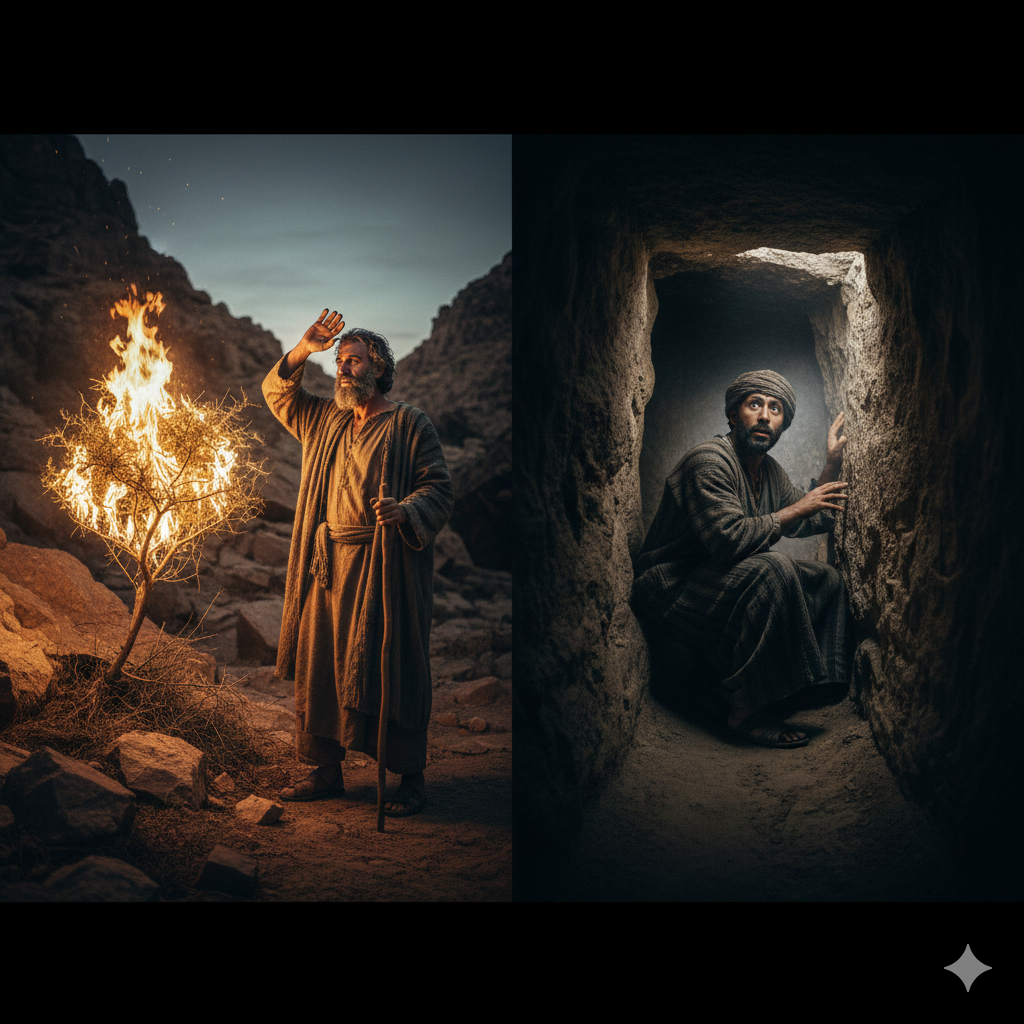
3. The Authentication Breakdown
If the Quran is a “confirmation” of the God of Moses, the "Challenge and Password" system has failed. Why would the God who gave Moses a password of historical identity give Muhammad a challenge of physical trauma and silence?
Approach this through the lens of “The First Impression.” You might say:
If your friend says, “All prophets are scared when they see an angel,” focus on Identity vs. Trauma.
“Muhammad was ‘unlettered,’ so God had to be more forceful. The trauma showed the weight of the revelation.”
“Moses was also just a shepherd who felt unqualified. God responded to his weakness with signs and a Name, not by leaving him in suicidal doubt. If the God of the Quran and the God of the Torah are the same, the pattern of calling prophets should be a ‘confirmation,’ not a total departure. The audit identifies a major inconsistency in how the God of history authenticates His messengers.”
In Phase 1, we are identifying Prophetic Authentication Patterns. A confirmation text must adhere to the established "legal" framework of the documents it claims to confirm. By highlighting the shift to unidentified trauma, you show that the Quranic narrative fails to authenticate itself using the very Blueprint it claims to uphold.