
In the military, there's a process called "Positive Identification" or PID. If you were calling in support or identifying a target, you couldn't just say, "I think it's the right building." You had to confirm it against the grid coordinates, the physical description, and the known intelligence on the ground. If the intelligence report said the target was a two-story blue house with a red door, and you were looking at a one-story brown shack, your "confirmation" was a failure. In the field, if the details don't match the original briefing, you don't have PID. The mission stops.
We are applying that same discipline to the Surah 4:82 Test. In our last lesson, we established that the Quran claims to be a Musaddiq—a "Confirmer." But today, we need to talk about what "confirmation" actually requires from a document. If the Quran is the "Update" and the Torah is the "Blueprint," they are logically tethered. If the Update changes the facts of the Blueprint, it isn't a confirmation; it's a contradiction.
The Claim
The Quran doesn't just claim to be a beautiful book or a guide for life. It claims to be a legal and historical verification of the scriptures that preceded it.
"And We have revealed to you, [O Muhammad], the Book in truth, confirming that which preceded it of the Scripture and as a guardian [Muhaymin] over it…"
The word Musaddiq (Confirmer) and Muhaymin (Guardian/Witness) are heavy words. In any audit, a "Guardian" document is responsible for protecting the integrity of the original data. This creates a Logical Tether. If the Quran is the Guardian of the Torah, it is bound by the historical facts already recorded in the Torah.
Under the Surah 4:82 Test, the Quran's divinity is tied to its consistency. If it "confirms" a story but changes the names of the people, the dates of the events, or the location of the action, the audit identifies a failure. Confirmation requires factual identity.
Evidence & Comparison
Let's look at what "Confirmation" looks like in the real world versus how it's often applied to the Quran.
1. The Logic of the Tether
Imagine you are a contractor building a house. You have the original Blueprint (the Torah). A new inspector comes by with an Update (the Quran) and says, "I am here to confirm the original Blueprint."
- If the Blueprint says the foundation is made of stone, but the Inspector says the foundation is made of wood, has he "confirmed" the Blueprint?
- No. He has contradicted it.
When the Quran says it "confirms" the life of Abraham, but places him 800 miles away from where the Blueprint says he was, it has broken the tether. According to Surah 4:82, "much contradiction" is the evidence of a human source.
2. The "In Your Hands" Requirement
For a confirmation to mean anything, the original document must be accessible and reliable. You can't confirm a ghost.
"…whom they find written in what they have with them of the Torah and the Gospel…"
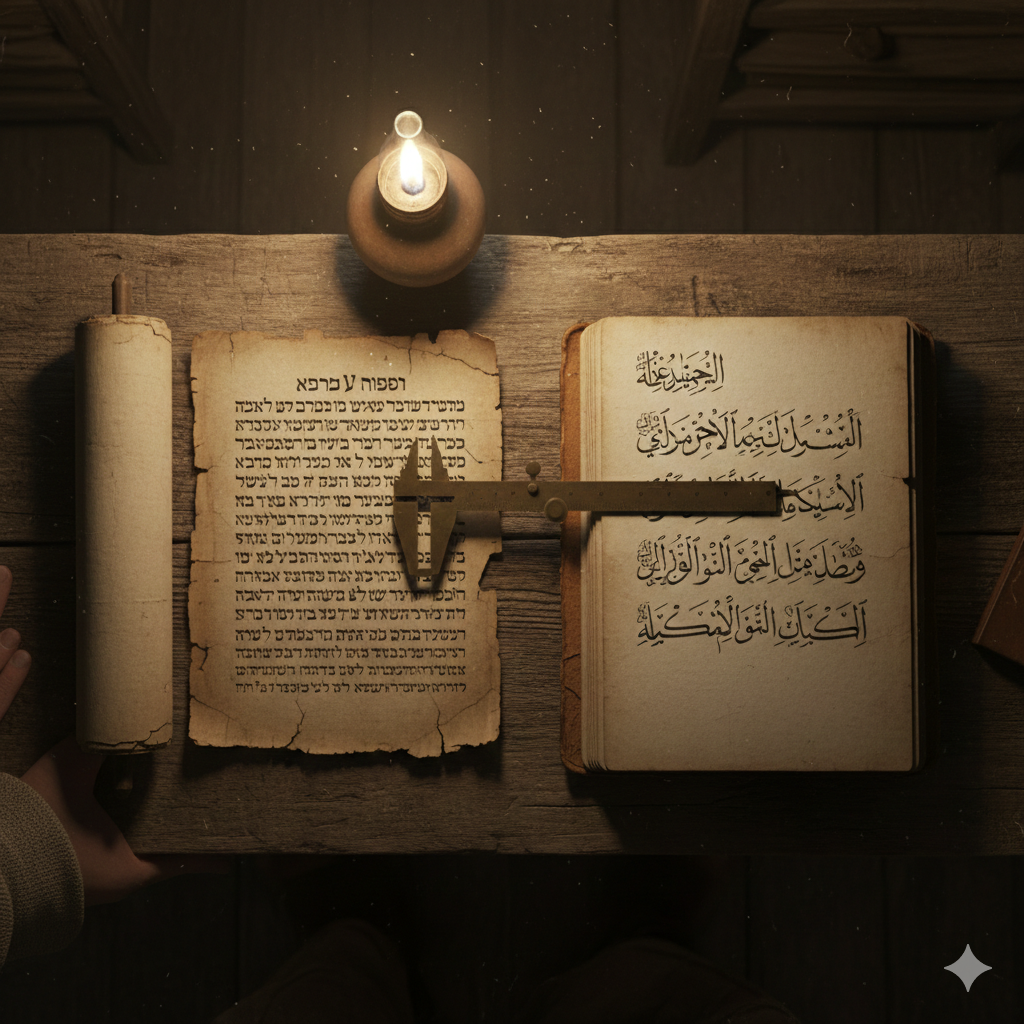
The Quran tells the 7th-century audience that the record is "with them." It doesn't say the record is lost, or that it's a secret version no one has seen. It points to the physical manuscripts they were holding. As we discussed in Lesson 1.1, those manuscripts (like the Dead Sea Scrolls and early New Kingdom records) are what we use as our Blueprint.
3. The Difference Between "Correcting" and "Confirming"
Many people will try to say the Quran "corrected" the previous books. But that's not what the word Musaddiq means.
- Correction says: "The first report was wrong."
- Confirmation says: "The first report was right, and I am here to verify it."
If the Quran is a "Correction," then it is calling the Torah a lie. But the Quran calls the Torah "Guidance and Light" (Surah 5:44). Therefore, the Quran has locked itself into a position where it must match the facts of the Torah to pass its own Surah 4:82 Test.
Think about your bank statement. If you go to the ATM and request a "Confirmation of Balance," you expect the number on the screen to match the number in your records. If your record says you have $1,000, but the "confirmation" says you have $10, you don't say, "Oh, the bank is just giving me a different perspective." You say, "There is a contradiction here, and someone is wrong." You can say this to a friend:
If your friend says, "The Quran confirms the spirit of the message, not every single name and date," use the Security Protocol.
"The original Torah was lost, so the Quran is confirming the 'True' Torah that only God knows."
"But the Quran says the people of the 7th century had the Torah 'with them' (Surah 7:157). If it was lost, God wouldn't tell them they were holding it. By pointing to the book in their hands, the Quran tethers itself to the physical manuscripts we still have today. If the Quran doesn't match the paper trail we can actually see and touch, then it fails the Audit. We can't use a 'hidden' book to pass a 'visible' test like Surah 4:82."
In this lesson, we are clarifying the Scope of Confirmation. We are teaching students that "Confirmation" is a high-stakes legal claim. It is the "Positive Identification" of history. If the Quran fails to provide PID for the stories of the prophets, it fails its own claim to be divine. We are moving the conversation away from "How I feel about the book" to "How the book handles the data."