
In the military, there's a specific way of handling “Conflicting Intelligence.” If one scout report says the enemy is moving north with three tanks, and a second report says the enemy is moving south with zero tanks, you don’t just say, “Well, they’re both right in their own way.” If you do that, people get killed. You recognize immediately that at least one of those reports is fundamentally flawed. They cannot both be an accurate reflection of the same reality at the same time. This is a matter of survival.
When we move from the battlefield to the paper trail of the prophets, we apply the same logic. It’s called the Law of Non-Contradiction. It’s a fancy term for a simple rule: Two contradictory statements cannot both be true at the same time and in the same sense. If the “Blueprint” says a prophet did X, and the “Confirmation” says he did Y, we have an intelligence failure. Today, we’re looking at why this law is the heart of the Surah 4:82 Test.
The Claim
The Quran doesn’t just ask for blind faith; it presents a logical challenge. It claims that its own internal and external consistency is the proof of its divine origin.
"Then do they not reflect upon the Qur’an? If it had been from [any] other than Allah, they would have found within it much contradiction."
This is the Surah 4:82 Test. The Quran is laying down a marker. It says, “If you find contradiction, then this book is from a human source.” To pass this test, the Quran must not only agree with itself, but it must agree with the “Blueprint” it claims to confirm. If it provides a narrative that contradicts the factual details of the Torah, it has created the very “contradiction” that proves a human origin.
In an audit, there is no "middle ground." If the Quran confirms the Blueprint, the audit passes. If it contradicts the facts of the Blueprint, the audit fails. Under Surah 4:82, the failure indicates a human source.
Evidence & Comparison
When we audit for contradiction, we aren’t looking at “opinions.” We are looking at “Coordinates”—names, places, dates, and lineages.
1. The Nature of God’s Consistency
In the “Blueprint,” God’s character is anchored in the fact that He does not change His story. He is the author of history, and He doesn’t get the details of His own work wrong.
"God is not a man, that He should lie, Nor a son of man, that He should repent; Has He said, and will He not do it? Or has He spoken, and will He not make it good?"
If God spoke the story of Moses to the authors of the Torah, and then “confirmed” it to Muhammad 1,500 years later, the facts should be identical. If they aren’t, the Law of Non-Contradiction tells us the second report didn't come from Headquarters.
2. Narrative vs. Interpretation
We must distinguish between how a story is told (perspective) and what the facts are (contradiction).
- Perspective: Two people see a car crash. One says the driver looked scared; the other says the driver looked angry. Both can be true.
- Contradiction: One says the car was a blue Ford; the other says it was a red Toyota. They cannot both be true.
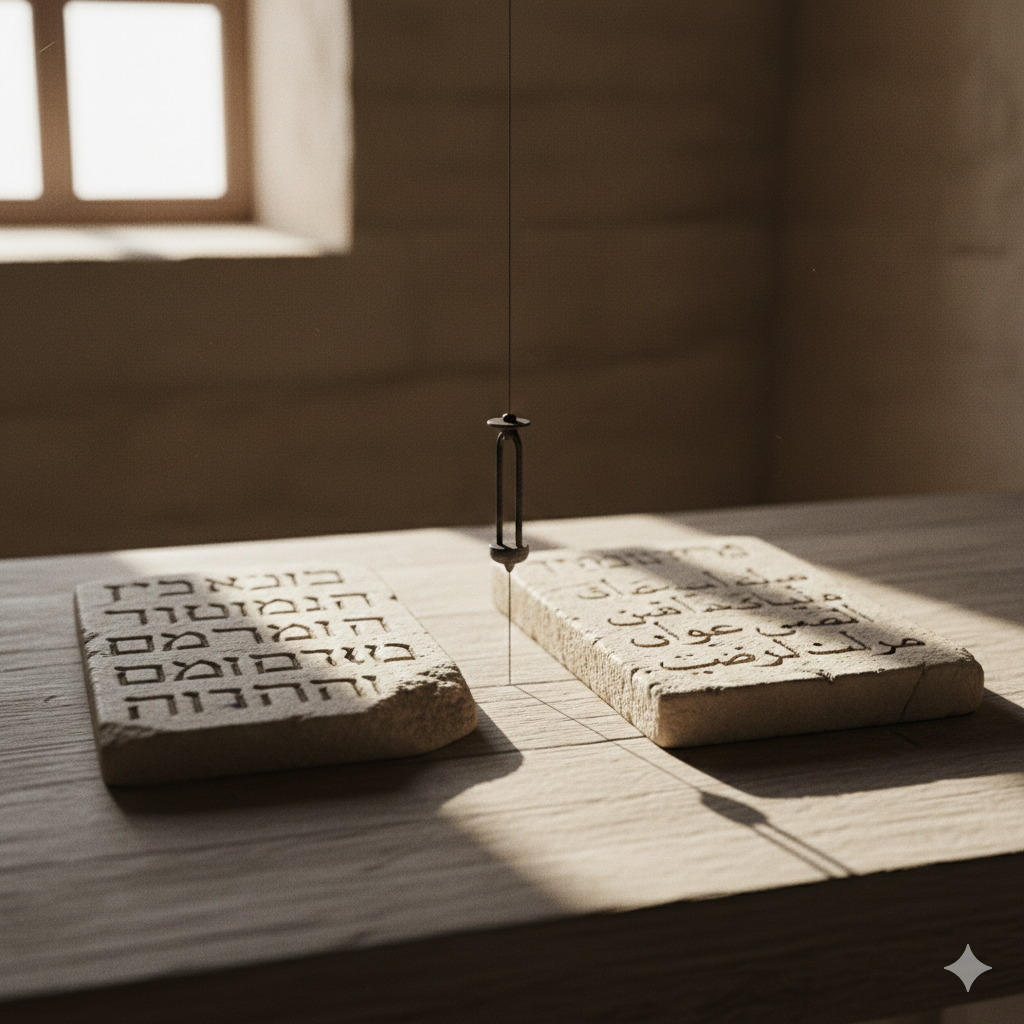
When the Quran says Mary is the sister of Aaron (separated by 1,500 years) or that Saul used Gideon’s river test, it isn’t giving a “different perspective.” It is giving a different “car.” It is a factual contradiction.
3. The Binary Result
In an audit, the result is binary. If the Quran fails its own consistency test by contradicting the Blueprint it claims to verify, the verdict is provided by the text itself: the book is "from other than Allah."
If you tell your child a story about their grandfather being a fisherman, and then ten minutes later you say he was a desert nomad who never saw the ocean, your child is going to stop you. They'll say, "Wait, which one is it?" They are naturally using the Law of Non-Contradiction. You can say this to a friend:
If your friend says, "Only God knows the full truth, so humans shouldn’t look for contradictions," use the Standard of the Text.
"What you call a contradiction is just God giving more information or a 'different' version for the Arabs."
"More information is fine, but 'different' information that reverses the facts is a contradiction. If the Torah says a man had two sons and the Quran says he had ten, that’s not 'more info'—that’s a factual conflict. According to Surah 4:82, if the details aren’t consistent, the source isn’t divine. We have to decide if we’re going to use the test God gave us or not."
In this lesson, we are solidifying the Binary of Truth. We are teaching students that the Surah 4:82 Test is a logical “Trapdoor.” Once a contradiction is identified in the narrative integrity or genealogy of the Quran, the book’s own claim to divinity collapses. We aren’t being mean; we are being logical. The “Audit Method” simply holds the book to its own word.