
In the military, there's a clear distinction between “Observer Perspective” and “Factual Coordinates.” If you're on a ridge looking at a village, you might say the houses look “crowded,” while a pilot flying overhead might say they look “orderly.” That’s a difference in perspective. But if you say the village is called “Al-Hillah” and the pilot says it’s “Baghdad,” or if you say the bridge is made of wood and he says it’s made of steel, we aren’t talking about perspective anymore. We are talking about a failure in intelligence. One of you is wrong.
When we audit the Quran’s claim to be a “Confirmation” of the previous scriptures, we have to be careful not to let “Different Perspective” become an excuse for “Factual Contradiction.” Today, we’re looking at the hard coordinates of the prophets: their names, their locations, and their family trees. In a Phase 1 audit, these are the data points that determine if the Surah 4:82 Test passes or fails.
The Claim
The Quran positions itself as a “Guardian” and “Confirmer” of the scriptures that came before it.
"And We have revealed to you, [O Muhammad], the Book in truth, confirming that which preceded it of the Scripture and as a criterion over it…"
To “confirm” a historical record, you must maintain the integrity of its coordinates. If a book claims to be a divine update to an existing Blueprint, it cannot change the names of the architects, the location of the build, or the lineage of the owners and still call itself a “confirmation.”
The Quran’s own standard in Surah An-Nisa 4:82 says that “much contradiction” is proof of a non-divine source. In this lesson, we define “Contradiction” as any narrative shift in Names, Places, or Lineage that violates the original record.
Evidence & Comparison
When you’re in a dialogue, you’ll often hear: “The Quran just tells the story from a different perspective.” We need to test that. Does the “Update” match the “Blueprint” on the hard data?
1. The “Coordinates” of Names
In the Blueprint (the Torah), names are not just labels; they are tied to specific meanings and histories.
- The Blueprint: Moses’ father is Amram (Exodus 6:20).
- The Confirmation: The Quran uses the Arabic form 'Imran (Surah 3:33).
- The Audit: While a name changing from Hebrew to Arabic is a language shift, the Quran takes the name of Moses’ father and applies it to the father of Mary (the mother of Jesus) 1,500 years later. That isn't a "perspective" shift; it's a coordinate error.
2. The “Coordinates” of Places
Geography is the most difficult thing to “fake” in an audit.
- The Blueprint: Abraham lives and builds altars in Hebron, Shechem, and Bethel—all in the land of Canaan (Genesis 12:7-8).
- The Confirmation: The Quran places Abraham in Mecca, building the Kaaba (Surah 2:127).
- The Audit: Mecca is 800 miles away from Abraham’s documented Area of Operations (AO). Either he was there, or he wasn't. If the Blueprint is silent on Mecca, the “Confirmation” is a contradiction of the map.
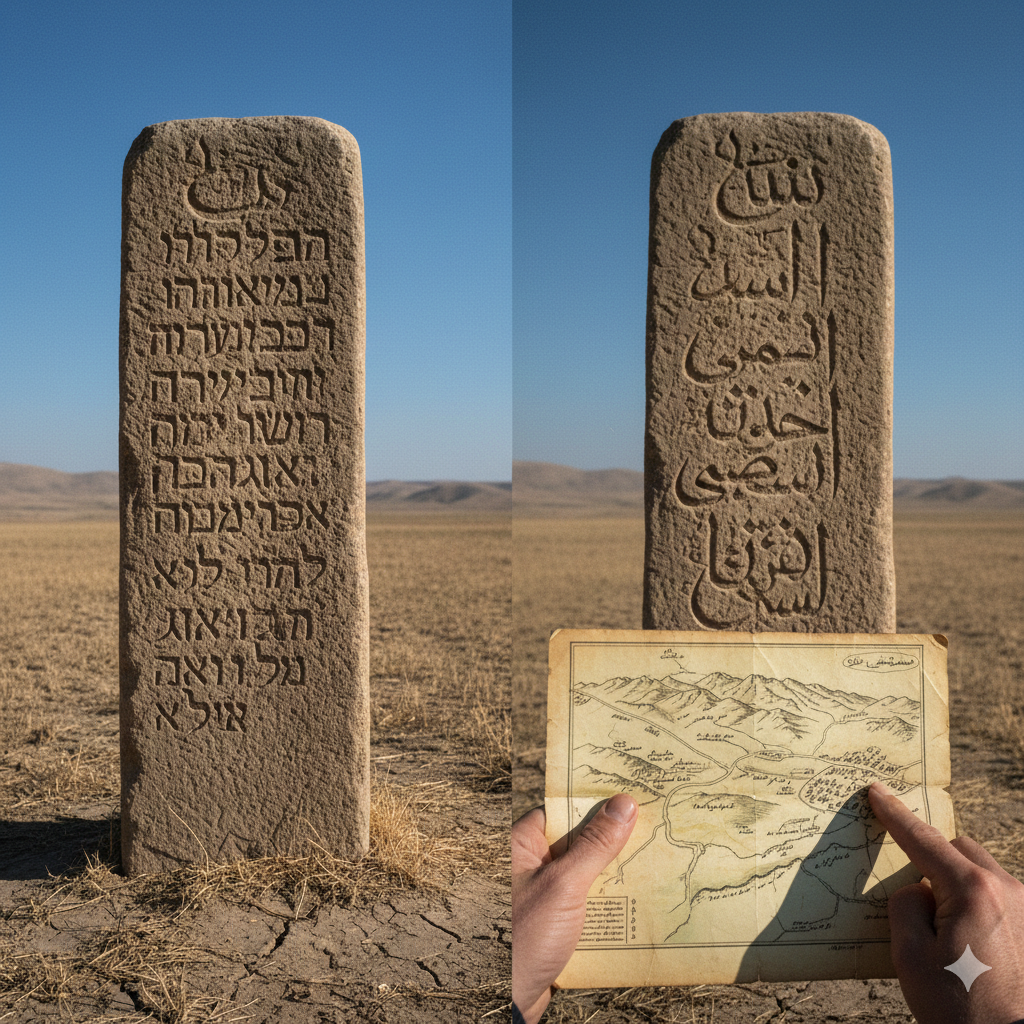
3. The “Coordinates” of Lineage
Lineage is the “Personnel File” of the prophets.
- The Blueprint: God’s covenant is established through Isaac, not Ishmael (Genesis 17:19-21).
- The Confirmation: The Quran shifts the focus of the sacrifice and the primary legacy toward Ishmael.
- The Audit: In a military line of succession, you can’t have two different “First-in-Commands.” If the records name different heirs for the same promise, they are in contradiction.
In our daily lives, we rely on “Factual Coordinates” for everything—from our GPS to our tax returns. We don’t accept “different perspectives” when it comes to our bank balance or our home address. You can say:
When your friend says, “It’s just a different perspective on the same story,” use the ID Card Analogy.
“Names and places change over time. ‘Imran’ is just the Arabic version of ‘Amram.’ It’s not a mistake; it’s just a translation.”
“Translation is fine. But the problem isn’t the spelling of the name; it’s the assignment of the name. If the ‘Confirmation’ takes the name of a man from the time of Moses and assigns him as the father of a woman 1,500 years later, that’s not a translation issue—it’s a chronological collapse. Identifying a woman as the sister of a man who died fifteen centuries before her is a contradiction. How does that pass the audit?”
In Phase 1, we are training students to stop accepting “vague spiritualizing” as an answer to “hard factual errors.” By categorizing discrepancies as Coordinates (Names, Places, Lineage), you give the student a concrete framework to evaluate the text. You are moving them from a subjective “I don’t like this” to an objective “The data doesn’t match the Blueprint.”